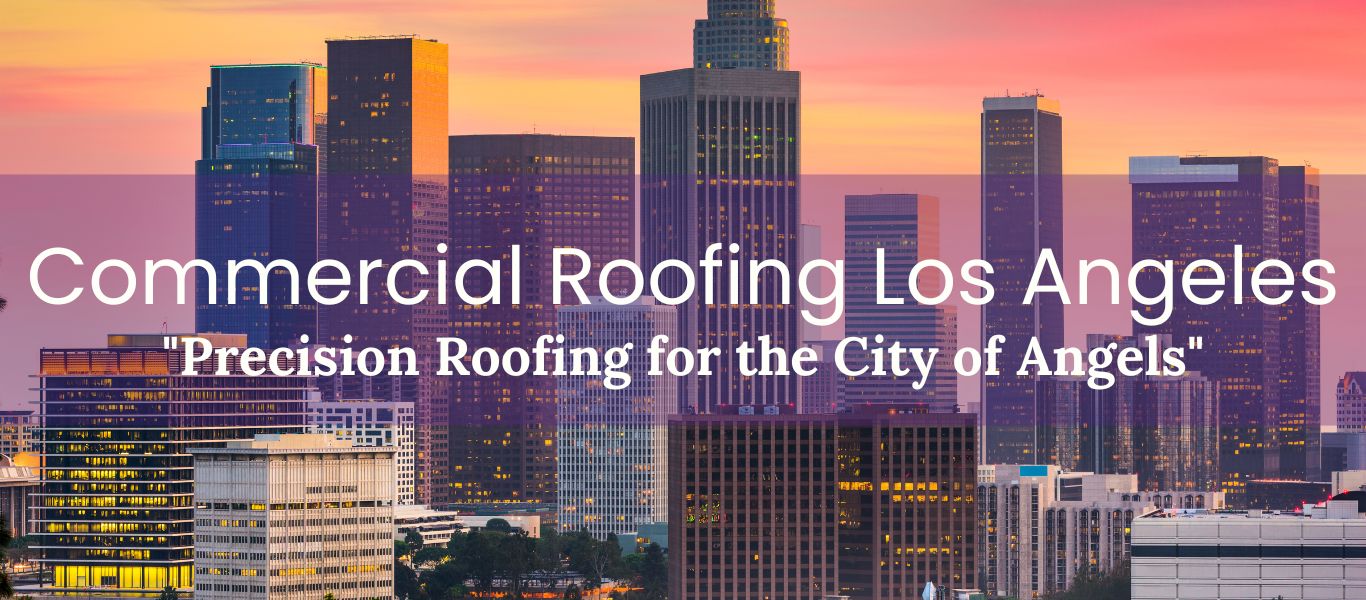
Commercial Roofing Los Angeles: LA and Los Angeles County Roofing Contractor
Commercial Roofing Los Angeles delivers comprehensive commercial and industrial roofing services engineered for the demanding environmental and regulatory conditions of Southern California. We provide services across Los Angeles County, Orange County, and the greater Los Angeles metropolitan area, supporting high-rise office towers in Downtown Los Angeles, logistics and warehouse corridors in the Inland Empire, coastal commercial properties, and large retail and mixed-use developments throughout Southern California. Commercial Roofing Los Angeles designs and installs roofing systems that reflect the structural diversity, heat exposure, seismic activity, and building-code requirements unique to the Los Angeles region. Southern California’s intense summer heat, seismic risk, coastal moisture, and periodic heavy rainfall place exceptional performance demands on commercial roofing. Every system we build is engineered to withstand extreme UV exposure, thermal expansion, wind uplift, and structural movement common across Los Angeles and surrounding counties.
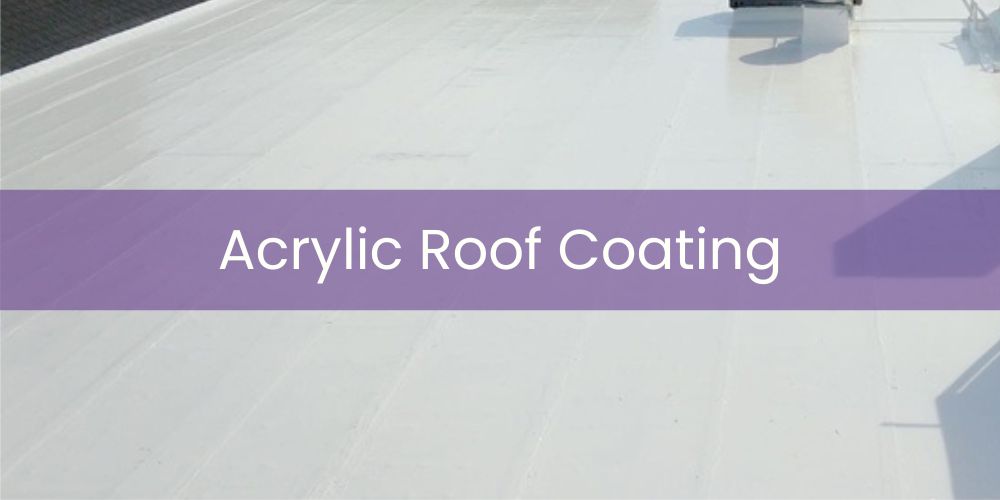
Commercial Roofing Los Angeles provides a full spectrum of professional services, including new commercial roof installations, targeted commercial roof repairs, preventative maintenance programs, full roof replacements, and detailed roof inspections. Each service is delivered with a focus on long-term durability, California Title 24 energy-efficiency compliance, fire-rating requirements, seismic resilience, and uninterrupted building operations for property owners, facility managers, and commercial tenants. By integrating advanced roofing technologies with high-performance materials such as TPO, PVC, EPDM, modified bitumen, cool-roof coatings, and architectural metal systems, Commercial Roofing Los Angeles helps reduce life-cycle costs while improving thermal performance, energy efficiency, and long-term weather resistance across large-scale commercial and industrial properties throughout Southern California.
What Is Commercial Roofing?
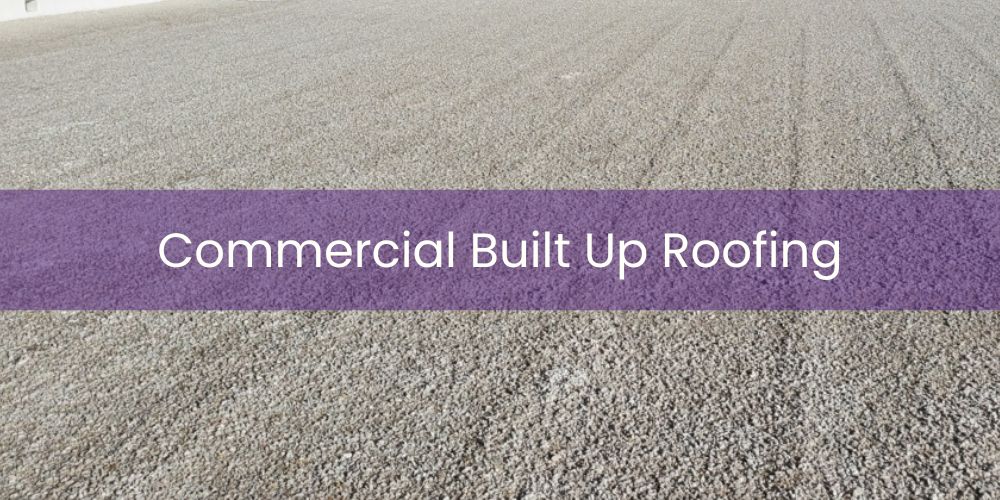
Commercial roofing in Los Angeles is the design, installation, maintenance, and repair of roofing systems built specifically for commercial and industrial buildings such as warehouses, factories, office towers, retail centers, and logistics facilities. Most commercial roofs in Los Angeles are flat or low-slope systems that rely on high-performance materials such as TPO, PVC, EPDM, metal panels, built-up roofing (BUR), and roof coatings. These roofing systems must deliver long-term waterproofing, energy efficiency, and structural stability while supporting heavy rooftop equipment and constant maintenance traffic. Without proper installation and preventative maintenance, commercial roofs in Los Angeles are vulnerable to UV degradation, membrane shrinkage, ponding water, seam failure, and costly roof leaks, all of which accelerate system failure and increase ownership costs.
Commercial roofing systems in Los Angeles and Southern California must be engineered for extreme heat, intense solar radiation, and high rooftop temperatures that routinely exceed 100°F during summer months. This makes reflective cool roof systems essential for commercial properties across Los Angeles and Orange County. Cool roofs use high-albedo membranes, reflective coatings, and light-colored roofing surfaces to minimize heat absorption, reduce cooling loads, and improve indoor comfort. California’s Title 24 Energy Efficiency Standards require cool roofing for most low-slope commercial buildings, hotels, multifamily properties, and major roof replacements. By reflecting solar radiation and lowering roof surface temperatures, cool roof systems play a critical role in reducing HVAC strain, energy consumption, and long-term operating costs for Los Angeles commercial buildings. Commercial roofing in Los Angeles must also be designed to withstand seismic activity. Located along the San Andreas Fault, the Los Angeles region experiences frequent ground movement that places stress on roof membranes, flashings, and mechanical attachments. Commercial roofing systems must remain flexible and securely fastened so they can tolerate building movement without cracking, tearing, or separating. Roofing assemblies that lack proper attachment methods or movement accommodation are far more likely to fail during earthquakes, leading to water intrusion and structural damage. For this reason, seismic-resistant fastening patterns, flexible membranes, and reinforced flashing systems are critical components of commercial roofing throughout Los Angeles and Orange County. Despite Southern California’s dry climate, heavy rain events during El Niño years regularly test commercial roofing systems across Los Angeles. Sudden downpours can overwhelm roofs with poor drainage design, causing ponding water, insulation saturation, and seam failure.
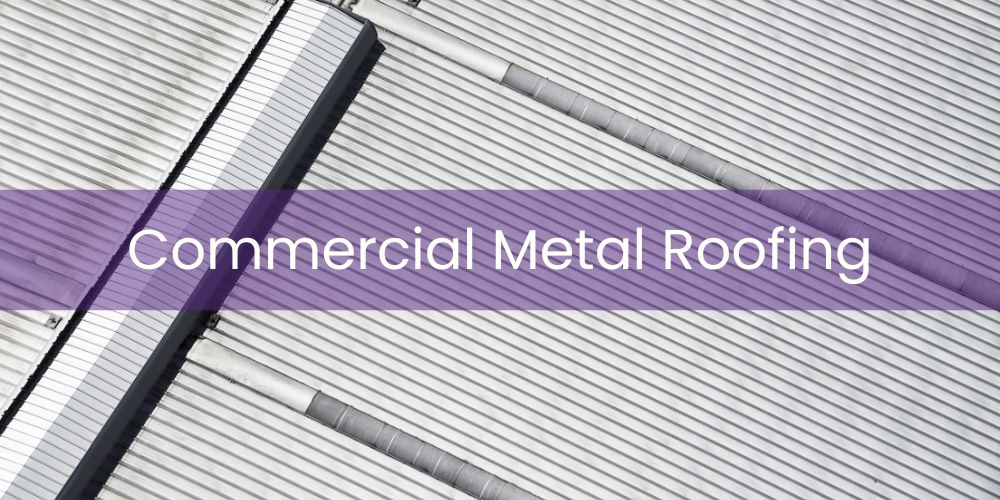
High-performance commercial roofing systems in Los Angeles use tapered insulation, reinforced seams, and fully welded membranes to direct water efficiently toward drains and scuppers. Proper drainage engineering prevents water buildup, reduces structural loading, and protects insulation and roof decks from long-term moisture damage. Fire resistance is another core requirement for commercial roofing in the Los Angeles area. California building codes require commercial roof assemblies in many zones to achieve Class A or Class B fire ratings, especially in fire-prone and urban environments. Class A roofing systems provide the highest level of protection against flame spread and burning embers and are tested under standards such as ASTM E108 and UL 790. Materials commonly used in Class A commercial roofing systems include metal roofing, TPO and PVC membranes with fire-retardant formulations, concrete tiles, and approved cover boards. Fire-rated roofing assemblies are essential for protecting commercial buildings, occupants, and adjacent properties across Los Angeles and Southern California. Commercial roofing systems in Los Angeles, Orange County, and Southern California must withstand extreme heat, seismic movement, heavy rain, and fire exposure while protecting high-value commercial properties. Choosing a properly engineered commercial roofing system determines whether a building receives decades of reliable protection or suffers premature failure, emergency commercial roof repairs, and costly operational disruption.
Have a question about an upcoming project?
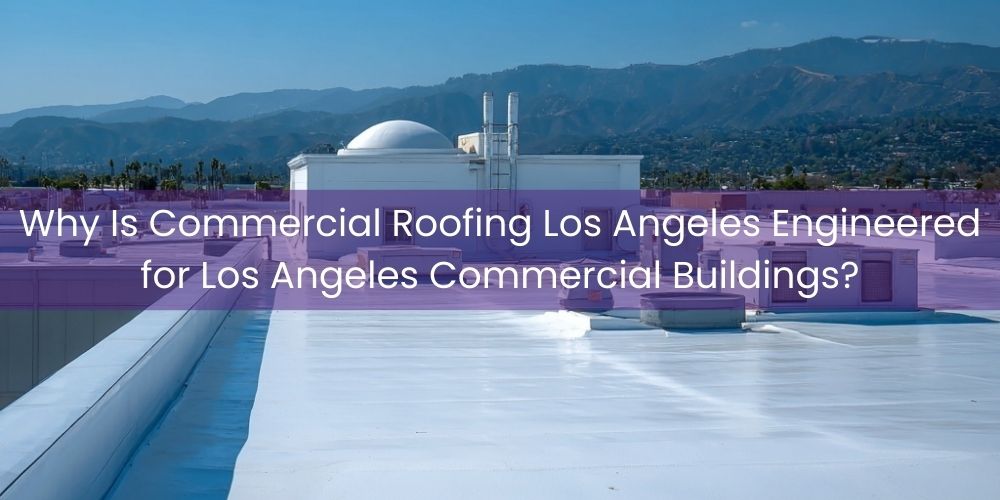
Why Is Commercial Roofing Los Angeles Engineered for Los Angeles Commercial Buildings?
Commercial Roofing Los Angeles is engineered for Los Angeles commercial buildings because every roofing system is designed to meet the city’s extreme heat, seismic activity, fire regulations, and energy-efficiency requirements. As a Los Angeles–focused commercial roofing brand, Commercial Roofing Los Angeles designs and installs roofing systems specifically for the realities of Los Angeles, not generic suburban or inland climates. Commercial buildings across Los Angeles — including high-rise offices, logistics and distribution centers, manufacturing facilities, retail complexes, and mixed-use developments — require advanced structural planning, heat-management strategies, and code-compliant fire-rated assemblies. Intense solar exposure, frequent seismic movement, wildfire risk, and strict California building standards all shape how commercial roofing systems must be built and maintained in Los Angeles. By aligning materials, attachment methods, and system layouts with these conditions, Commercial Roofing Los Angeles delivers roofing systems that protect high-value Los Angeles buildings while ensuring long-term performance and regulatory compliance across Southern California and Orange County.
- Commercial Roofing Los Angeles engineers roof systems for extreme heat and solar exposure.
- Commercial Roofing Los Angeles builds every roof to meet California Title 24 and fire-rating standards.
- Commercial Roofing Los Angeles designs roofing systems for seismic movement, wind uplift, and weather exposure.
- Commercial Roofing Los Angeles accounts for rooftop equipment, drainage, and limited roof access.
- Commercial Roofing Los Angeles integrates all Los Angeles-specific factors into every commercial roofing project.
These Los Angeles-specific engineering decisions create the following material-level roof performance outcomes:
- Commercial Roofing Los Angeles–engineered heat-reflective assemblies → reduce rooftop temperatures → cooling loads and energy costs decrease
- Seismically secured roof attachment systems specified by Commercial Roofing Los Angeles → tolerate building movement → membranes and flashings do not tear during earthquakes
- Fire-rated roof assemblies selected by Commercial Roofing Los Angeles → comply with California fire codes → fire-spread and insurance risk is minimized
- Drainage geometries designed by Commercial Roofing Los Angeles → evacuate heavy rain → ponding water does not damage insulation or seams
- High-durability membranes and coatings chosen by Commercial Roofing Los Angeles → resist UV and rooftop traffic → wear does not become leak paths
Each of these material-level performance outcomes is produced by a specific combination of thermal, seismic, fire-rating, drainage, and membrane engineering systems, which are detailed below.
1. Commercial Roofing Los Angeles Engineers Roof Systems for Los Angeles’s Heat-Exposed and Low-Slope Buildings
Commercial Roofing Los Angeles designs commercial roofing systems around the thermal realities of Los Angeles, where most commercial and industrial buildings rely on flat or low-slope roof assemblies installed on steel, concrete, and lightweight structural decks that are exposed to intense year-round solar radiation. These roofs must support substantial dead and live loads, including HVAC systems, cooling equipment, ductwork, solar arrays, grease exhaust fans, and continuous maintenance traffic while being subjected to extreme heat and ultraviolet exposure. Without proper insulation layering and thermal management, Los Angeles roofs can suffer from accelerated membrane aging, insulation breakdown, and structural stress caused by constant expansion and contraction. Commercial Roofing Los Angeles evaluates deck type, insulation R-values, fastener pull-out strength, membrane reflectivity, and rooftop equipment layout before specifying a roofing system. This allows the roof assembly to be engineered with the correct attachment methods, insulation profiles, and reinforcement zones to manage heat, weight, and movement. By controlling thermal loading and structural stresses, Commercial Roofing Los Angeles delivers roofing systems that remain watertight, stable, and energy-efficient throughout their service life.
2. Commercial Roofing Los Angeles Builds Code-Compliant and Fire-Rated Roofing Systems for California Commercial Buildings
Commercial Roofing Los Angeles installs commercial roofing systems that meet the strict requirements of the California Building Code, California Fire Code, and insurance underwriting standards that govern commercial properties throughout Los Angeles and Orange County. In wildfire-prone and dense urban areas, roof assemblies must achieve Class A fire ratings, incorporate approved cover boards, and use membranes tested for flame spread, heat release, and fire penetration resistance. These fire-safety requirements are critical for protecting building occupants, neighboring structures, and property owners from catastrophic loss. Commercial Roofing Los Angeles specifies roofing assemblies that are UL-listed and FM-approved and installs them using fastening patterns, perimeter securement, and edge-metal systems that meet or exceed California wind and fire standards. Every layer of the roofing system — from vapor barrier and insulation to cover board and membrane — is selected to comply with inspections, energy regulations, and insurance audits. This ensures Los Angeles commercial buildings receive roofing systems that pass compliance checks, qualify for coverage, and reduce long-term regulatory and liability risk.
3. Commercial Roofing Los Angeles Designs Roofs to Withstand Seismic Activity, Wind, and Southern California Weather
Commercial Roofing Los Angeles designs commercial roofing systems for the seismic and weather conditions that affect Los Angeles buildings, where earthquakes, wind events, and rapid temperature changes place continuous stress on roof assemblies. Seismic movement causes buildings to shift, flex, and vibrate, which can tear poorly secured membranes, crack flashings, and loosen mechanical attachments. In addition, seasonal storms and coastal weather patterns expose Los Angeles roofs to wind-driven rain and uplift forces that can compromise roof edges and penetrations. Commercial Roofing Los Angeles specifies flexible membranes, reinforced attachment patterns, and perimeter securement systems designed to tolerate building movement and resist wind uplift. Seams are heat-welded for long-term bond strength, and flashing systems are engineered to remain sealed during seismic activity and heavy rain. By designing each layer of the roofing system for movement, moisture, and wind, Commercial Roofing Los Angeles protects commercial roofs from leaks, storm damage, and earthquake-related failure.
4. Commercial Roofing Los Angeles Manages Rooftop Equipment, Drainage, and Access on Los Angeles Buildings
Commercial Roofing Los Angeles designs roofing systems around the complex rooftop environments common on Los Angeles commercial buildings, where HVAC units, exhaust systems, ductwork, solar panels, and electrical equipment occupy large portions of the roof surface. These rooftop systems restrict water flow, create point loads, and increase wear on membranes and insulation. Older buildings throughout Los Angeles and Orange County often have legacy drainage layouts that are no longer adequate for today’s rainfall patterns or rooftop congestion. Commercial Roofing Los Angeles uses tapered insulation systems to establish positive drainage, directing water efficiently toward drains and scuppers even when equipment and parapet walls limit runoff. Reinforced walk pads and service pathways protect roof membranes from maintenance traffic, while fully welded curbs and equipment supports prevent movement and water intrusion around mechanical units. This approach allows Los Angeles commercial roofs to remain watertight, serviceable, and resistant to long-term wear caused by constant rooftop use.
5. Commercial Roofing Los Angeles Integrates All Los Angeles-Specific Requirements into Every Commercial Roofing Project
Commercial Roofing Los Angeles approaches every commercial roofing project as a fully engineered system rather than a collection of individual components. Structural load capacity, heat management, fire resistance, seismic resilience, drainage performance, and rooftop equipment layout are evaluated together before a roofing system is selected. This ensures the roof not only meets California codes but performs reliably in real Los Angeles operating conditions. By coordinating insulation design, membrane selection, fastening methods, fire-rated assemblies, and flashing details into one integrated system, Commercial Roofing Los Angeles delivers roofing solutions that protect high-value buildings, reduce emergency repairs, and extend service life across Los Angeles, Orange County, and Southern California.
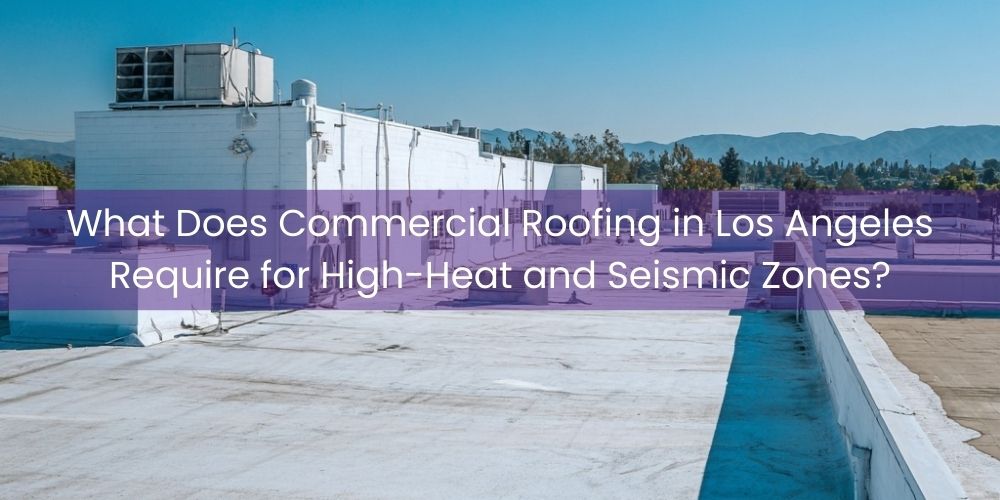
What Does Commercial Roofing in Los Angeles Require for High-Heat and Seismic Zones?
Commercial roofing in Los Angeles requires thermally engineered, seismically resilient roofing systems designed to withstand extreme heat, intense solar exposure, and frequent ground movement across Southern California. As a Los Angeles–focused commercial roofing brand, Commercial Roofing Los Angeles designs and installs roof systems specifically for the environmental and structural realities of Los Angeles and Orange County, not generic inland or temperate climates. Most commercial buildings in Los Angeles rely on flat or low-slope roofing assemblies that must endure rooftop temperatures exceeding 160°F, continuous UV radiation, mechanical vibration, and periodic seismic shifting without membrane failure or water intrusion. California energy codes, wildfire regulations, and earthquake-resistance standards also directly influence how commercial roofs must be constructed, fastened, and maintained. By aligning materials, attachment methods, and system design with these high-heat and seismic conditions, Commercial Roofing Los Angeles delivers roofing systems that protect buildings, reduce energy costs, and ensure long-term performance throughout Southern California.
- Thermal Load and Solar Exposure Requirements for Los Angeles Commercial Roofs
- Seismic-Resistant Roof Attachment Systems for Los Angeles Buildings
- Cool-Roof Membranes and Energy-Efficient Assemblies for Southern California
- Drainage Design for Sudden Rain Events in Los Angeles
- Fire-Rated and Code-Compliant Roofing Requirements in Los Angeles
The Los Angeles–specific engineering requirements that govern commercial roofing performance include:
- High-reflectivity membranes → reduce rooftop heat → HVAC loads decrease
- Seismic-rated fastening → absorbs building movement → membranes do not tear
- Fire-rated assemblies → comply with California codes → wildfire and insurance risk is reduced
- Engineered drainage → evacuates sudden rainfall → ponding water does not degrade insulation
- UV-resistant materials → tolerate solar exposure → membranes do not prematurely crack or fail
These environmental and structural forces define how every commercial roofing system must be engineered for Los Angeles, Orange County, and the wider Southern California region.
1. Thermal Load and Solar Exposure Requirements for Los Angeles Commercial Roofs
Commercial roofing in Los Angeles must be engineered for extreme heat and intense solar exposure that routinely pushes rooftop surface temperatures far beyond 100°F. Flat and low-slope commercial roofs absorb massive amounts of solar radiation, placing constant thermal stress on membranes, insulation, adhesives, and fasteners. Without proper thermal design, this heat causes accelerated UV degradation, membrane shrinkage, seam fatigue, and insulation breakdown that leads to leaks and premature system failure. Thermal expansion and contraction further strain roof assemblies, especially around penetrations, curbs, and perimeter edges where movement is concentrated. To control these forces, Los Angeles commercial roofing systems require high-albedo cool-roof membranes, UV-resistant materials, and insulation packages designed to limit heat transfer into the building. Reflective TPO, PVC, and coated membrane systems reduce rooftop temperatures, stabilize thermal movement, and protect roofing materials from long-term solar damage. High-density insulation and cover boards maintain dimensional stability under heat, preventing compression, warping, and fastener loosening over time. By engineering roof assemblies around Los Angeles’s extreme thermal environment, Commercial Roofing Los Angeles delivers roofing systems that maintain membrane integrity, reduce cooling loads, and provide long-term performance across commercial buildings throughout Southern California.
2. Seismic-Resistant Roof Attachment Systems for Los Angeles Commercial Buildings
Commercial roofing in Los Angeles must be engineered to withstand seismic movement because the region sits on multiple active fault lines, including the San Andreas Fault, which produces frequent ground motion that transfers stress directly into roof decks, fasteners, and membrane systems. During earthquakes, buildings flex, shift, and vibrate, causing rigid roofing assemblies to crack, fasteners to loosen, and seams to separate if systems are not designed for movement. Commercial Roofing Los Angeles specifies flexible membranes, reinforced attachment patterns, and movement-tolerant flashing systems that allow the roof assembly to absorb structural motion without tearing or losing watertight integrity. Single-ply systems such as TPO, PVC, and EPDM are commonly used in Los Angeles because their elasticity allows them to stretch and recover during seismic events, unlike brittle roofing materials that fracture under stress. These membranes are installed using fastening and adhesive systems that are tested for both wind uplift and seismic shear forces, ensuring the roof remains anchored even when the building shifts. Perimeter securement, penetration flashings, and expansion joints are engineered to accommodate differential movement between roof sections, parapet walls, and mechanical curbs. By combining flexible membranes with seismically rated attachment systems, Commercial Roofing Los Angeles delivers commercial roofing assemblies that remain sealed, stable, and fully functional even after ground movement, protecting Los Angeles commercial buildings from leaks, structural exposure, and costly post-earthquake repairs.
3. Thermal Load and Solar Exposure Control for Los Angeles Commercial Roofs
Commercial roofing in Los Angeles must be engineered to manage some of the highest rooftop temperatures in the country due to intense solar radiation, clear skies, and prolonged heat waves that routinely push roof surface temperatures well above 150°F. These extreme thermal loads cause roof membranes, insulation, adhesives, and flashing systems to expand, contract, and age far faster than in cooler climates. Without proper thermal design, excessive heat leads to membrane embrittlement, seam fatigue, adhesive failure, and premature roof breakdown. Commercial Roofing Los Angeles specifies roofing systems built to resist thermal cycling, ultraviolet exposure, and long-term heat stress that defines Southern California’s climate. High-reflectivity cool-roof membranes, light-colored PVC and TPO sheets, and advanced roof coatings are used to reduce heat absorption and lower rooftop temperatures across Los Angeles and Orange County. These materials reflect solar energy instead of absorbing it, keeping both the roofing system and the building structure cooler while reducing HVAC demand and interior heat gain. Beneath the membrane, high-performance insulation layers and cover boards are selected to maintain thermal stability, protect adhesives, and prevent heat from degrading the roof assembly from below. By controlling solar gain, thermal expansion, and ultraviolet exposure, Commercial Roofing Los Angeles delivers commercial roofing systems that remain dimensionally stable, energy efficient, and structurally intact under Southern California’s relentless sun, ensuring long-term performance on warehouses, office buildings, logistics facilities, and retail complexes throughout the region.
4. Drainage Design for Sudden Rain Events in Los Angeles
Commercial roofing in Los Angeles must be engineered for extreme rain events that occur during El Niño cycles and seasonal Pacific storms, where large volumes of water can fall in short periods and overwhelm poorly designed roof systems. Even though Southern California is known for a dry climate, commercial roofs across Los Angeles and Orange County regularly experience flash flooding, roof ponding, and drainage overload when storms hit. Flat and low-slope commercial roofs are especially vulnerable, as standing water increases structural load, accelerates membrane degradation, and forces moisture into seams, insulation, and roof decks. Commercial Roofing Los Angeles designs drainage systems that move water off the roof quickly and predictably, even when rooftop equipment, parapet walls, and mechanical curbs restrict natural flow paths. Tapered insulation is used to create positive slope toward internal drains, scuppers, and overflow outlets, eliminating low spots where water can accumulate. Reinforced drain bowls, fully welded drain connections, and properly spaced overflow drains ensure that heavy rainfall is evacuated without allowing water to back up across the roof surface. By engineering slope, drainage pathways, and water-exit capacity into every roof assembly, Commercial Roofing Los Angeles protects commercial buildings from ponding pressure, insulation saturation, and storm-driven leaks that commonly occur during Southern California’s sudden rain events. This drainage engineering is a critical reason Los Angeles commercial roofs remain watertight, structurally sound, and operationally reliable throughout the year.
5. Fire-Rated and Code-Compliant Roofing Requirements in Los Angeles
Commercial roofing in Los Angeles must be engineered to meet some of the most demanding fire-safety and building-code standards in the United States due to the region’s wildfire risk, dense urban development, and strict regulatory environment. Roof assemblies in many parts of Los Angeles and Southern California are required to achieve Class A or Class B fire ratings, ensuring resistance to flame spread, burning embers, and radiant heat during fire events. These standards are critical for protecting commercial buildings, adjacent properties, and occupants in high-risk fire zones and densely built commercial districts. Commercial Roofing Los Angeles installs fire-rated roofing systems using tested and approved assemblies that include fire-resistant cover boards, insulation layers, and membranes that have been evaluated under standards such as ASTM E108 and UL 790. These assemblies are selected not just for compliance, but for their ability to prevent fire penetration through the roof surface and to limit heat transfer into the building. Secure perimeter fastening, edge-metal systems, and penetration flashings are also designed to prevent embers from entering vulnerable roof openings during wildfire or structural fire exposure. By using UL-listed and FM-approved roofing assemblies that meet California building codes, insurance underwriting requirements, and municipal fire-safety standards, Commercial Roofing Los Angeles ensures that commercial roofs pass inspections, remain insurable, and provide long-term fire protection. Fire-rated and code-compliant roofing is not optional in Los Angeles — it is a fundamental requirement for protecting commercial properties, maintaining occupancy approval, and reducing catastrophic loss in Southern California’s high-risk fire environment.
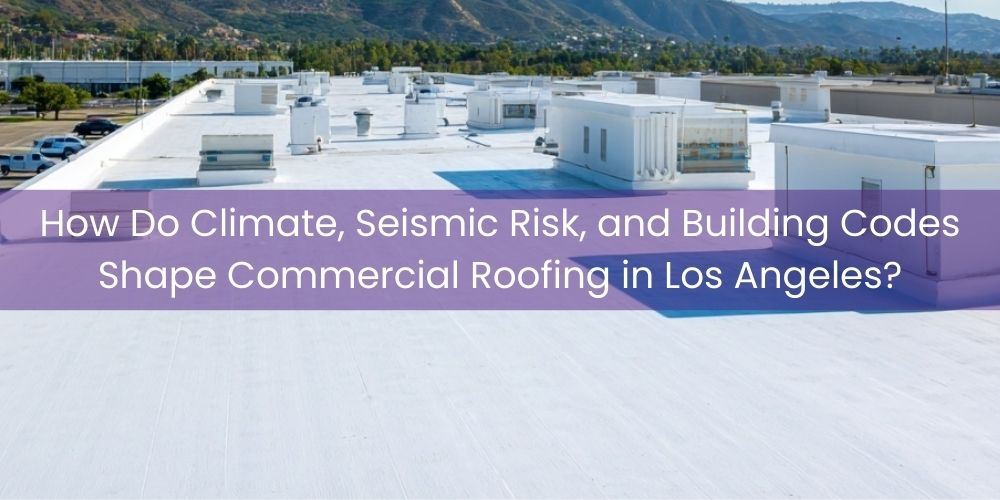
How Do Climate, Seismic Risk, and Building Codes Shape Commercial Roofing in Los Angeles?
Commercial roofing in Los Angeles is not governed by a single condition — it is shaped by the combined forces of extreme heat, seismic risk, wildfire exposure, and some of the most demanding building and energy codes in the country. California building regulations control fire resistance, energy efficiency, fastening methods, and roof assembly performance, while insurance standards and municipal inspections further determine which commercial roofing systems are allowed on Los Angeles properties. At the same time, constant solar exposure, high rooftop temperatures, and periodic heavy rain events place continuous thermal and moisture stress on roof membranes, insulation layers, and flashing systems, particularly on TPO, PVC, and cool-roof assemblies widely used across Southern California. Seismic activity adds another layer of complexity. Los Angeles sits on active fault systems that subject commercial buildings to ongoing ground movement, structural vibration, and shifting loads. Roof membranes, fasteners, flashing details, and equipment curbs must remain flexible and securely attached to prevent tearing, separation, or water intrusion during earthquakes. Roof design further multiplies these forces. Flat and low-slope commercial roofs must support HVAC units, ductwork, solar arrays, and constant service access while also shedding heat, draining water, and remaining watertight under thermal expansion and seismic movement. In Los Angeles, these forces interact — extreme heat accelerates membrane aging, earthquakes stress fastening systems, and fire codes determine which materials can be installed at all. Commercial Roofing Los Angeles addresses these challenges as a fully integrated roofing system rather than a collection of separate components. Thermal performance, seismic resistance, fire ratings, drainage design, membrane selection, fastening patterns, and long-term maintenance requirements are evaluated together before any roofing system is specified. This system-level engineering ensures Los Angeles commercial roofs are not only code-compliant, but capable of surviving Southern California’s climate, seismic activity, and operational demands for decades.
- Los Angeles building and fire codes define which commercial roofing assemblies are permitted.
- Extreme heat and solar exposure dictate membrane composition and reflectivity.
- Seismic activity controls fastening methods and structural attachment design.
- Flat-roof geometry requires engineered drainage and load management.
- Rooftop equipment and access needs shape membrane protection and flashing systems.
The forces that govern how Los Angeles commercial roofs must be built include:
- California fire and energy codes → control approved roof assemblies → non-compliant systems cannot be legally installed
- Extreme solar exposure and heat → accelerate membrane aging → cool-roof materials and UV resistance are required
- Seismic movement → creates structural shifting → membranes and fasteners must tolerate motion without tearing
- Flat-roof geometry → traps rainwater → drainage must prevent ponding and insulation damage
- System-level interaction → links all variables → failure in one area compromises the entire roof
Each of these forces drives a specific engineering requirement in Los Angeles commercial roofing.
1. California Building Codes and Fire Regulations Define Which Commercial Roofing Systems Are Allowed in Los Angeles
Commercial roofing in Los Angeles is governed by some of the strictest fire-safety and energy-efficiency regulations in the United States due to the region’s wildfire risk, dense development, and climate mandates. Commercial roof systems must achieve Class A or Class B fire ratings and are often required to include approved cover boards, fire-resistant insulation, and tested membrane assemblies such as TPO and PVC. These materials are selected not just for durability, but for their ability to resist flame spread, airborne embers, and radiant heat in fire-prone commercial districts. Fastening patterns, edge securement, and roof-to-wall connections are also regulated by California building codes and insurance underwriting standards to prevent roof failure that could endanger adjacent properties or occupants. When an existing commercial roof no longer meets current fire-rating, energy-performance, or attachment requirements, commercial roof replacement becomes mandatory — repairs alone cannot bring a non-compliant system back into code. This is why many Los Angeles commercial roofing projects are driven by regulatory compliance as much as by physical roof condition.
2. Extreme Heat and Solar Exposure Dictate Membrane Composition and Reflectivity in Los Angeles
Commercial roofing in Los Angeles must be engineered to survive some of the highest sustained rooftop temperatures in the country due to constant solar exposure and extended heat cycles. Roof membranes, adhesives, and insulation layers are exposed to intense UV radiation that accelerates aging, dries out polymers, and weakens seams on poorly specified systems. For this reason, Los Angeles commercial roofs rely on heat-stable membranes such as TPO and PVC, along with high-reflectivity cool-roof surfaces that limit heat absorption and thermal expansion. These materials are selected not only to reduce cooling loads, but to prevent membrane cracking, seam failure, and long-term fatigue caused by extreme surface temperatures. When older dark roofs or non-reflective membranes no longer meet current energy and heat-performance standards, replacement is often required because coatings or repairs cannot restore thermal stability. This makes heat and solar exposure a primary driver of material selection and system design for commercial roofing in Los Angeles.
3. Seismic Activity Controls Fastening Methods and Structural Attachment on Los Angeles Commercial Roofs
Commercial roofing in Los Angeles must be engineered to tolerate constant ground movement and seismic shifting caused by the region’s active fault systems. Earthquakes place stress on roof membranes, fasteners, flashing details, and equipment curbs as buildings flex, shift, and vibrate. Roofing systems that are rigid, weakly attached, or improperly detailed are prone to tearing, seam separation, and water intrusion during seismic events. For this reason, Los Angeles commercial roofs require flexible membranes, reinforced attachment patterns, and secure perimeter and penetration details that allow controlled movement without system failure. When existing roofs lack seismic-rated fastening or movement-tolerant assemblies, repairs cannot restore structural resilience, making full commercial roof replacement necessary to meet safety and performance requirements. This is why seismic forces are a core engineering driver for commercial roofing in Los Angeles.
4. Flat-Roof Geometry Requires Engineered Drainage and Load Management on Los Angeles Commercial Buildings
Because flat and low-slope roofs dominate Los Angeles commercial construction, drainage design is one of the most critical factors in roof performance and service life. Even in a dry climate, sudden rain events and El Niño storms can overwhelm poorly designed roofs, leading to ponding water that increases structural loads, saturates insulation, and accelerates membrane deterioration. Rooftop equipment and parapet walls further restrict natural water flow, creating low points where water collects and causes leaks. Los Angeles commercial roofing systems therefore require tapered insulation, properly located drains, and overflow pathways to move water off the roof before it creates structural or waterproofing failures. When existing roofs have chronic ponding, clogged drains, or saturated insulation, repairs cannot restore proper drainage, making full commercial roof replacement necessary to correct load and water-management problems.
5. Rooftop Equipment and Access Requirements Shape Membrane Protection and Flashing Systems in Los Angeles
Los Angeles commercial rooftops are heavily occupied by HVAC units, exhaust systems, solar arrays, ductwork, and service walkways that require constant technician access. Every piece of rooftop equipment creates penetrations through the roof membrane and introduces vibration, foot traffic, and abrasion that can damage poorly protected roofing systems. Without reinforced curbs, welded flashings, and protected service paths, membranes wear quickly, seams fail, and leaks develop around equipment bases. Los Angeles commercial roofing systems therefore require heavy-duty flashing details, reinforced walk pads, and vibration-tolerant attachment methods to protect the roof surface from daily operational stress. When older roofs lack these protective systems, repeated service activity leads to widespread leakage, making full commercial roof replacement the only viable long-term solution.
How Is Commercial Roofing Priced for Los Angeles Buildings?
Commercial roofing costs in Los Angeles are driven by heat, seismic risk, fire codes, and energy regulations, not just square footage. Unlike mild-climate regions, commercial roofs in Los Angeles must be engineered to withstand extreme solar exposure, high rooftop temperatures, earthquake movement, wildfire risk, and strict Title 24 energy standards. These forces require cool-roof membranes, heat-resistant materials, fire-rated assemblies, and seismic-tolerant fastening systems, all of which increase system complexity and installation cost. In addition, Los Angeles commercial buildings often carry large HVAC units, solar arrays, exhaust systems, and maintenance walkways that place continuous stress on roof membranes and insulation layers. Drainage systems must be engineered to handle sudden El Niño rain events while still maintaining slope on flat or low-slope roof decks. Because of these factors, commercial roofing in Los Angeles is priced based on material performance, heat reflectivity, seismic fastening, fire classification, deck type, access limitations, and code compliance, not just labor and material quantity. High-performance systems such as TPO, PVC, EPDM, modified bitumen, metal roofing, built-up roofing, and liquid-applied coatings are all widely used across Los Angeles and Orange County, but their installed cost varies based on the energy ratings, wind and seismic resistance, and fire-safety approvals required for each project.
| Roofing System | Typical Los Angeles Installed Range |
|---|---|
| TPO Roofing | $5 – $9 per sq ft |
| EPDM Roofing | $6 – $10 per sq ft |
| PVC Roofing | $7 – $12 per sq ft |
| Built-Up Roofing (BUR) | $5 – $9 per sq ft |
| Modified Bitumen Roofing | $4 – $8 per sq ft |
| Metal Roofing | $10 – $18 per sq ft |
| Roof Coatings | $2 – $6 per sq ft |
| Roof Inspections | $250 – $500 |
| Preventative Maintenance | $0.10 – $0.30 per sq ft annually |
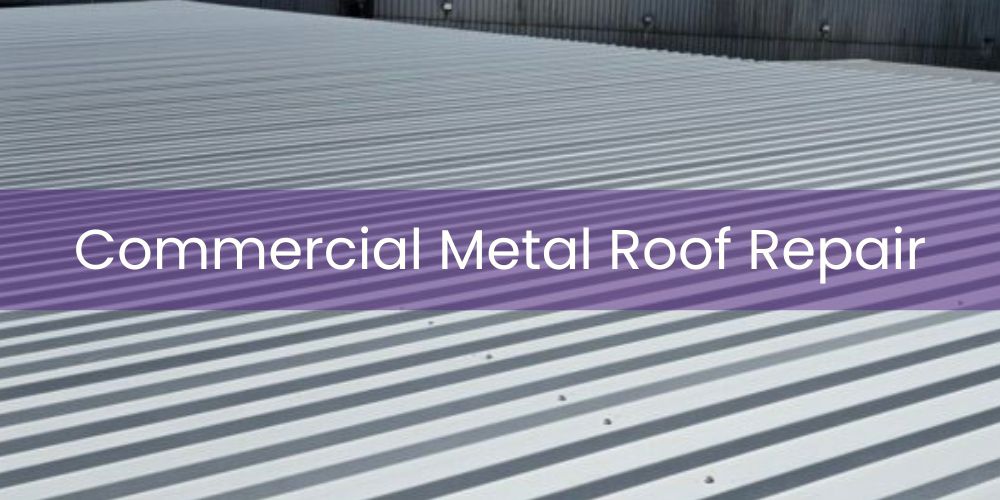
| Roof Repairs | $250 – $3,000+ depending on scope |
Los Angeles Pricing Disclaimer: These ranges reflect typical commercial roofing conditions in Los Angeles, Orange County, and Southern California. Pricing varies based on roof size, deck type, heat-reflectivity requirements, seismic fastening, fire rating, access limitations, rooftop equipment density, and Title 24 compliance. Exact pricing requires a site-specific engineering evaluation.
When Does a Los Angeles Commercial Roof Need Professional Attention?
If your building is in Los Angeles, even small membrane defects, drainage restrictions, or aging flashings can quickly escalate under extreme heat, intense UV exposure, seismic movement, and seasonal heavy rain. Commercial Roofing Los Angeles, a leading commercial roofing contractor in Los Angeles, evaluates how your specific roof is performing under real Southern California conditions, including thermal stress, seam integrity, drainage behavior, structural attachment, and code compliance. This allows hidden weaknesses to be identified before heat cycles, earthquakes, or storm events drive moisture beneath the roofing system. If you are seeing ponding water, recurring leaks, rising energy costs, or visible membrane wear, Commercial Roofing Los Angeles can assess your roof and determine the technically correct next step, whether that is targeted repair, restoration, or full system replacement. Request a commercial roof inspection or system review to see how your roof is actually performing on your Los Angeles building.