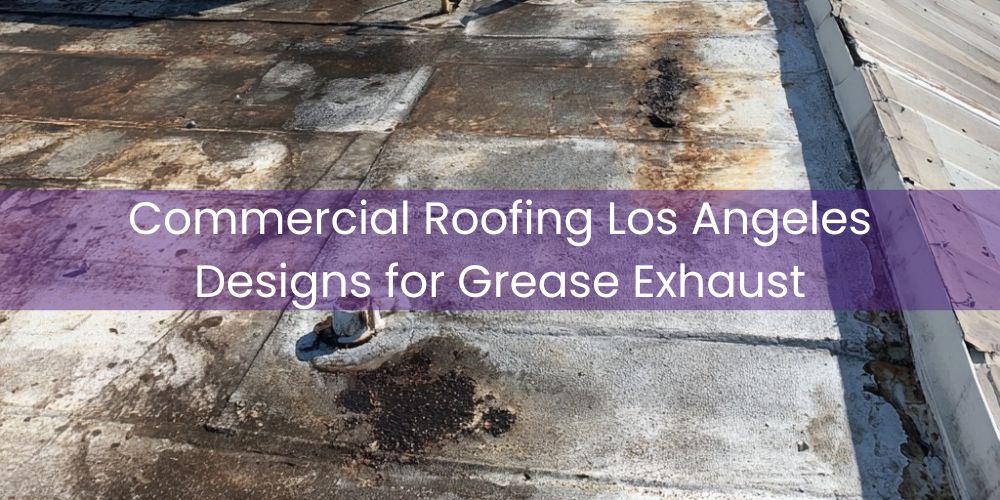
Commercial Roofing Los Angeles designs commercial roofing systems across Los Angeles specifically to protect commercial buildings from roof system degradation caused by grease exhaust and industrial contaminants. In Los Angeles’s dense commercial and industrial environment, low-slope roofs are routinely exposed to grease vapors, cooking oils, hydrocarbons, acids, and airborne particulates discharged from commercial kitchens, manufacturing processes, and industrial exhaust systems. These contaminants settle on roof membranes, coatings, seams, flashings, and penetrations, where they soften polymers, break down protective surfacing, and weaken the components responsible for maintaining waterproofing continuity. Over time, chemical exposure causes swelling, adhesion loss, and surface degradation that compromise roof assemblies at critical interfaces. If not addressed at the design level, ongoing exposure to grease and industrial contaminants creates latent vulnerabilities that develop into leaks, membrane failure, and premature roof deterioration. Commercial Roofing Los Angeles engineers roof systems specifically to tolerate prolonged exposure to grease exhaust and industrial contaminants without losing structural stability or waterproofing performance. By selecting chemically resistant membranes, protective surfacing, compatible sealants, and contamination-tolerant detailing methods, we design roofs that maintain integrity under continuous exhaust exposure. These systems allow commercial buildings to remain watertight, operational, and financially protected despite persistent exposure to grease and industrial emissions common throughout Los Angeles.
How Do Commercial Roof Designs Protect Los Angeles Buildings From Grease Exhaust and Industrial Contaminants?
Los Angeles commercial roofs operate under persistent chemical stress created by grease exhaust and industrial emissions rather than isolated contamination events. Grease vapors, oils, and airborne contaminants condense on roof surfaces and interfaces, where they penetrate membranes, soften sealants, and reduce adhesion at seams, flashings, and penetrations. On the low-slope concrete, steel, and wood-framed commercial buildings common throughout Los Angeles, this chemical interaction develops gradually, weakening material performance without causing immediate leaks. Over time, contaminated surfaces lose tensile strength and bonding capacity, creating localized separation that later becomes active failure pathways during routine rain events. Commercial Roofing Los Angeles designs commercial roofing systems for Los Angeles because controlling contaminant-driven chemical degradation at the assembly level is the only way to prevent this failure mechanism. Roof membranes and coatings are selected for resistance to oils, fats, acids, and industrial byproducts so chemical exposure does not compromise material integrity prematurely. Seam, flashing, and penetration details are engineered to limit contaminant absorption and maintain adhesion under continuous exhaust exposure. By managing how grease exhaust and industrial contaminants interact with membranes, sealants, fasteners, and interfaces, chemical stress is prevented from progressing into separation, moisture intrusion, and premature roof failure. This system-level approach allows commercial roofs in Los Angeles to withstand ongoing exhaust and contaminant exposure while remaining dry, stable, and fully operational throughout their service life.
How Do Grease Exhaust and Industrial Contaminants Create Failure Pathways on Los Angeles Commercial Roofs?
Grease exhaust and industrial contaminants create failure pathways on Los Angeles commercial roofs by chemically degrading the materials and interfaces responsible for waterproofing continuity and mechanical restraint. Grease vapors, oils, acids, and airborne particulates discharged from commercial kitchens and industrial processes condense on roof membranes, coatings, seams, flashings, and penetrations. On the low-slope concrete, steel, and wood-framed commercial buildings common throughout Los Angeles, these contaminants do not remain inert on the surface. Instead, they penetrate membranes, soften polymers, reduce tensile strength, and weaken adhesion at bonded interfaces. This chemical interaction develops gradually, creating localized softening, swelling, and loss of restraint rather than immediate leaks. Over time, contaminated interfaces form latent separation zones that become active failure pathways during routine rain events when water exploits chemically weakened materials. Commercial Roofing Los Angeles designs commercial roofing systems for Los Angeles because preventing contaminant-driven chemical degradation at the material and interface level is the only way to stop this failure mechanism. Roof assemblies are engineered to resist oils, fats, acids, and industrial byproducts so chemical exposure does not compromise waterproofing performance. Chemically resistant membranes and coatings are specified to prevent softening and swelling under grease exposure. Seam, flashing, and penetration details are engineered to maintain adhesion and restraint even as surfaces are exposed to ongoing exhaust contamination. Detailing around exhaust discharge zones is designed to limit contaminant accumulation and reduce prolonged contact with vulnerable materials. By controlling how grease exhaust and industrial contaminants interact with membranes, sealants, fasteners, and interfaces, chemical stress is prevented from progressing into mechanical separation, moisture intrusion, and premature roof failure.
The contaminant-driven failure mechanisms described above can be reduced to direct cause-and-effect relationships between chemical exposure, material degradation, and moisture intrusion below.
- Grease vapor deposition → membrane softening and swelling → loss of surface integrity
- Oil and acid exposure at seams → adhesion breakdown → interface separation
- Contaminant saturation at penetrations → sealant degradation → direct water entry
- Industrial particulates on coatings → protective layer breakdown → substrate exposure
- Chemically resistant materials and detailing → stabilized interfaces → failure pathways do not form
Have a question about an upcoming project?
Where Does Grease Exhaust and Industrial Contaminant Degradation Concentrate on Los Angeles Commercial Roofs?
Commercial roofing systems on buildings in Los Angeles experience grease exhaust and industrial contaminant degradation as a chemically induced stress that concentrates at roof locations exposed to exhaust discharge, surface accumulation, and prolonged contact with oils and byproducts. In Los Angeles’s dense commercial and industrial environment, grease vapors and airborne contaminants do not disperse evenly across roof assemblies. Instead, they settle and condense near exhaust fan outlets, along prevailing airflow paths, and at surfaces where contaminants can pool or adhere. These areas experience sustained chemical exposure that accelerates material softening, adhesion loss, and protective surface breakdown compared to uninterrupted roof fields. Exhaust discharge zones and surrounding roof surfaces experience the highest concentration of grease-driven degradation. Grease vapors condense as they cool, depositing oils and acids onto membranes, coatings, and flashing details near exhaust fans and duct terminations.
Over time, these deposits penetrate membranes, soften polymers, and weaken seam adhesion and flashing bonds. As chemical degradation advances, these locations develop localized softening and separation that later become active leak entry points during routine rainfall. Seams, penetrations, and flashing transitions form another primary concentration zone for contaminant-driven degradation because they combine material interfaces with increased exposure. Grease and industrial residues accumulate along seam edges, penetration collars, and flashing terminations, where sealants and bonding agents are exposed to repeated chemical attack. This exposure reduces tensile strength and adhesion, allowing micro-separation to form. Once separation occurs, these interfaces create direct pathways for moisture intrusion beneath the roof membrane. Roof surfaces with low slope, surface irregularities, or poor drainage further intensify contaminant concentration by allowing grease residues and particulates to dwell rather than wash away. In these areas, prolonged contact accelerates coating breakdown and membrane degradation, increasing vulnerability at attachment points and transitions. Grease exhaust and industrial contaminant degradation concentrate at these locations because chemical stress accumulates where materials are exposed, bonded, or interrupted. Roof systems that fail to control contaminant exposure at exhaust zones, seams, penetrations, and low points allow chemical degradation to convert into mechanical separation, moisture entry, and progressive roof system failure.
In Los Angeles, grease exhaust and industrial contaminants create predictable roof failure paths at exhaust discharge zones, seams, penetrations, and low-slope accumulation areas; these failure paths can be reduced to direct cause-and-effect relationships between contaminant deposition, chemical degradation, and moisture migration below.
- Grease deposition near exhaust fans → membrane softening → localized separation
- Oil and acid accumulation at seams → adhesion loss → interface failure
- Contaminant saturation at penetrations → sealant degradation → direct water entry
- Residue pooling on low-slope surfaces → coating breakdown → substrate exposure
- Chemically resistant detailing and drainage → reduced accumulation → failure pathways do not form
When Do Grease Exhaust and Industrial Contaminants Require Professional Roofing Intervention in Los Angeles?
Grease exhaust and industrial contaminants require professional roofing intervention on Los Angeles commercial roofs when chemical exposure has begun to compromise membranes, seams, flashings, penetrations, or attachment points, but the roof deck and insulation remain structurally serviceable. On low-slope commercial buildings in Los Angeles, early indicators include membrane softening or swelling near exhaust discharge zones, loss of adhesion at seams or flashing terminations, sealant degradation around penetrations, surface staining or residue buildup that persists after rainfall, or leaks that appear following routine rain events rather than prolonged storms. These conditions signal that grease- and contaminant-driven chemical degradation is no longer being resisted at the surface level and is beginning to convert latent material weakening into active failure pathways. Under Los Angeles operating conditions, where commercial kitchens and industrial exhaust systems discharge contaminants continuously, intervention is appropriate when degradation is confined to surface materials, interface bonds, and localized attachment points rather than widespread insulation saturation or deck deterioration. At this stage, professional evaluation focuses on membrane chemical resistance, seam and flashing adhesion, penetration detailing, fastener condition, exhaust discharge patterns, and subsurface moisture presence to determine whether targeted corrective work can arrest contaminant-driven failure progression. When addressed before chemical degradation advances into uncontrolled separation and moisture migration, professional intervention stabilizes waterproofing continuity, limits further material breakdown, and delays the need for full roof replacement despite ongoing exposure to grease exhaust and industrial contaminants.