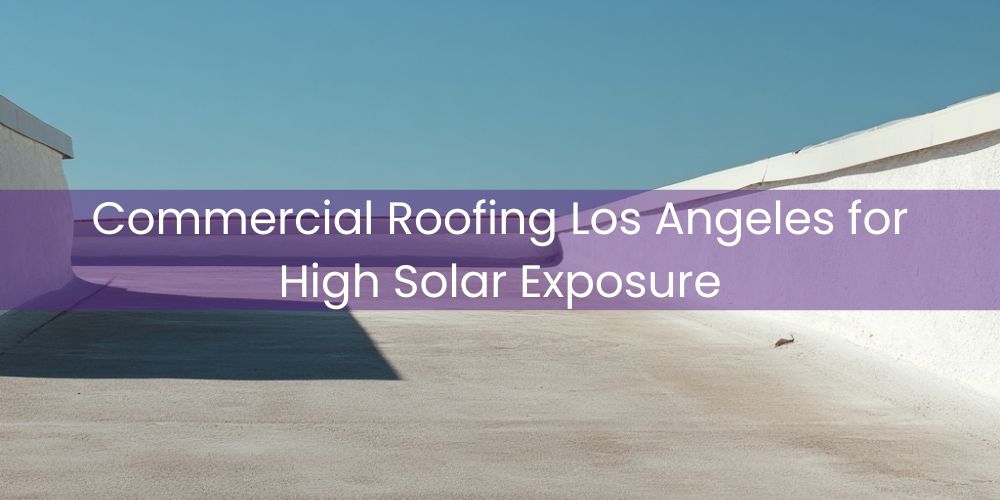
Commercial Roofing Los Angeles designs commercial roofing systems across Los Angeles to protect commercial buildings from heat-driven roof failure caused by sustained solar exposure and ultraviolet radiation. In Southern California’s climate, commercial roofs are subjected to intense daily sun that elevates surface temperatures, accelerates material aging, and increases thermal movement across roof assemblies. These conditions place continuous stress on membranes, seams, flashings, and penetrations, creating the underlying degradation that leads to leaks and premature roof failure if not addressed at the design level. Commercial Roofing Los Angeles engineers roof systems specifically to tolerate prolonged solar loading without losing waterproofing performance or structural stability. By selecting materials and assembly methods that control heat absorption, thermal expansion, and UV degradation, we design roofs that maintain integrity under Los Angeles’s high-solar conditions. These systems allow commercial buildings to remain watertight, operational, and financially protected year after year despite constant sun exposure.
How Do Commercial Roof Designs Protect Los Angeles Buildings From Solar-Driven Roof Failure?
Los Angeles commercial roofs operate under one of the most consistent solar stress environments in North America, with long daylight hours, minimal cloud cover, and year-round ultraviolet exposure. This constant solar loading heats roof surfaces daily, causing repeated expansion and contraction that dries sealants, weakens seam bonds, and oxidizes membranes over time. On the low-slope concrete, steel, and wood-framed buildings common throughout Los Angeles, this heat-driven movement creates microscopic separations at seams, penetrations, and attachment points where water intrusion later develops during rain events. Once moisture enters these openings, it migrates laterally beneath the roof system, saturating insulation and spreading damage far beyond the original entry point. We design commercial roofing systems for Los Angeles because controlling solar-driven degradation at a material level is the only way to stop this failure mechanism. Heat-reflective membranes and coatings reduce surface temperatures and slow ultraviolet oxidation, limiting the daily thermal movement that pulls seams apart. Flexible, UV-stable membranes retain elasticity under prolonged sun exposure, allowing the roof assembly to expand and contract without cracking or separating. Reinforced seam construction and compatible adhesives are used to absorb thermal stress so waterproofing continuity is preserved even after years of solar cycling.
Commercial Roofing Los Angeles engineers roof assemblies to manage the cumulative effects of heat, UV radiation, and thermal movement that define Los Angeles roof performance. By reducing heat absorption, preserving material flexibility, and stabilizing seams and penetrations, solar-driven degradation is prevented from progressing into active leak pathways. This system-level approach is what allows commercial roofs in Los Angeles to withstand constant solar exposure without premature failure, keeping buildings dry, protected, and operational throughout their service life.
What Is Commercial Roofing Design for High Solar Exposure in Los Angeles?
Commercial roofing design for high solar exposure in Los Angeles focuses on protecting roof assemblies from heat-driven degradation caused by prolonged ultraviolet radiation and elevated surface temperatures. In this climate, constant solar loading accelerates membrane oxidation, dries sealants, and intensifies daily expansion and contraction across roof systems. Over time, these forces weaken seams, flashings, penetrations, and fastener interfaces, creating latent leak pathways that become active once rainfall or condensation is introduced. Commercial Roofing Los Angeles designs commercial roof systems in Los Angeles to interrupt these solar-driven failure mechanisms at the material and assembly level. Roof designs are engineered to limit heat absorption, preserve material flexibility, and stabilize critical interfaces so thermal movement does not evolve into seam separation, cracking, or water intrusion on low-slope commercial buildings.
To withstand high solar exposure, roof design decisions must directly counter how heat and ultraviolet radiation create and propagate leak pathways through the roof system.
- Reflective roof membranes and coatings → reduce solar heat absorption → thermal expansion cycles are limited
- UV-stable membrane compounds → resist ultraviolet oxidation → membranes retain elasticity under constant sun exposure
- Reinforced seam construction → absorbs daily thermal movement → seams do not separate or fatigue over time
- Flexible flashing and penetration detailing → accommodates heat-driven expansion → leak pathways do not form at transitions
- Heat-tolerant sealants at fasteners → maintain adhesion under solar loading → water does not enter at attachment points
Have a question about an upcoming project?
Where Does High Solar Exposure Drive Roof Failure On Commercial Buildings In LA?
Commercial Roofing Los Angeles focuses on the roof zones where sustained solar exposure concentrates thermal stress and initiates leak pathway formation on Los Angeles commercial buildings. On low-slope roof assemblies, prolonged heat and ultraviolet radiation accelerate sealant shrinkage, membrane oxidation, and daily expansion and contraction, causing separation at seams, penetrations, and perimeter transitions. These separations become the primary entry points for water once rainfall occurs, allowing moisture to migrate beneath the roof system and spread beyond the original failure location. Seams on low-slope commercial roofs experience some of the highest thermal movement under constant sun exposure. As materials repeatedly expand and contract, seam bonds fatigue and lose continuity, creating openings where water can enter and move laterally beneath the membrane. We interrupt this failure path by reinforcing seam construction and restoring flexibility at bond lines so thermal movement is absorbed without separation, preventing solar-driven seam fatigue from developing into active leak pathways.
Roof penetrations, including equipment curbs and drains, represent another critical solar stress concentration zone. Continuous heat exposure causes sealants and flashing materials at these transitions to dry and lose adhesion faster than surrounding roof areas. Once compromised, these interfaces allow water to bypass the membrane surface and saturate insulation layers below. By stabilizing penetration details with heat-tolerant materials and flexible sealing systems, moisture migration is blocked before insulation saturation and secondary structural damage can occur. Perimeter edges and parapets are also vulnerable under Los Angeles solar conditions due to direct sun exposure and amplified thermal movement at termination points. When edge details lose elasticity, water entering at the roof perimeter can travel beneath the roof assembly and affect interior walls and structural components. Thorough sealing and stabilization of perimeter transitions prevent solar-exacerbated separation from becoming a migration route for water into the building envelope.
To withstand high solar exposure, roof detailing must directly counter how heat creates and propagates leak pathways through the roof system.
- Seam reinforcement → limits heat-driven bond separation → lateral moisture migration beneath the membrane is prevented
- Penetration stabilization → maintains seal integrity under thermal cycling → insulation layers remain dry
- Perimeter and parapet sealing → absorbs solar-induced movement at terminations → water does not enter at roof edges
When Do Los Angeles Commercial Roofs Require Professional Evaluation?
If your Los Angeles commercial roof is experiencing recurring leaks, persistent ponding, seam separation, deterioration around penetrations, or corrosion at fasteners and edge details, these conditions indicate that solar-driven degradation may be compromising the roof system beyond surface-level wear. Under sustained high solar exposure, daily thermal cycling, and coastal moisture, roofing materials lose elasticity, seals shrink, and seams fatigue, allowing water to migrate beneath the membrane even before widespread interior damage is visible. Commercial Roofing Los Angeles evaluates whether these issues are isolated or part of a broader system-level failure driven by heat and ultraviolet exposure. We assess material condition, moisture migration paths, and the roof’s suitability for continued service under Los Angeles climate conditions to determine whether targeted stabilization can arrest deterioration or whether more comprehensive intervention is required. If you are managing recurring roof issues, escalating maintenance costs, or early signs of heat-related failure, we can determine when professional evaluation is necessary to prevent further asset damage and operational disruption.