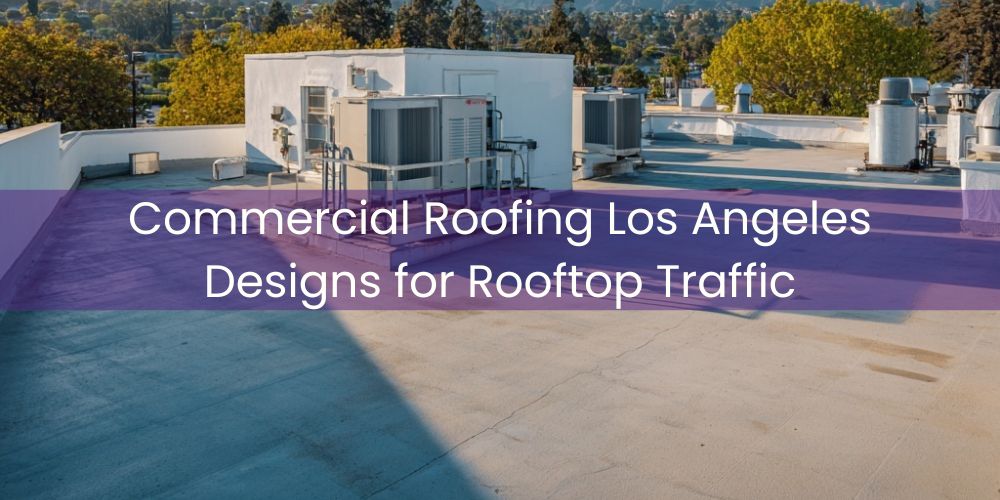
Commercial Roofing Los Angeles designs commercial roofing systems across Los Angeles specifically to protect commercial buildings from roof system degradation caused by rooftop foot traffic and service loads. In Los Angeles’s dense commercial environment, low-slope roofs are routinely accessed for HVAC servicing, equipment inspections, telecommunications work, and general building maintenance. Each access event introduces concentrated point loads, repetitive foot traffic, and localized abrasion across roof surfaces. Over time, these mechanical stresses compress insulation, fatigue membranes, damage protective surfacing, and weaken seams, flashings, and attachment points responsible for maintaining waterproofing continuity. If not addressed at the design level, routine rooftop access creates latent vulnerabilities that develop into leaks, membrane punctures, and premature roof failure. Commercial Roofing Los Angeles engineers roof systems specifically to tolerate repeated foot traffic and service loads without losing structural stability or waterproofing performance. By selecting load-resistant membranes, reinforced walking surfaces, impact-tolerant insulation assemblies, and compatible attachment methods, we design roofs that maintain integrity under constant rooftop use. These systems allow commercial buildings to remain watertight, operational, and financially protected despite ongoing rooftop access required for day-to-day building operations.
How Do Commercial Roof Designs Protect Los Angeles Buildings From Rooftop Foot Traffic and Service Loads?
Los Angeles commercial roofs operate under persistent mechanical stress created by routine rooftop access rather than isolated events. Foot traffic from service technicians, equipment maintenance, and inspections applies repeated point loading and abrasion to roof membranes, seams, and protective surfaces. On low-slope concrete, steel, and wood-framed commercial buildings common throughout Los Angeles, these stresses gradually compress insulation, reduce membrane thickness, and weaken bonded and mechanically restrained interfaces. This degradation does not typically cause immediate leaks but creates localized deformation and separation that later become active failure pathways during normal rain events. Commercial Roofing Los Angeles designs commercial roofing systems for Los Angeles because controlling traffic-induced mechanical stress at the assembly level is the only way to prevent this failure mechanism. Roof membranes are selected for puncture resistance, tear strength, and abrasion tolerance so surface damage does not accumulate prematurely. Reinforced walk pads and designated service pathways are integrated to distribute loads away from vulnerable areas. Seam, flashing, and penetration details are engineered to maintain restraint and waterproofing continuity as materials experience repeated loading. By managing how foot traffic and service loads are transferred through membranes, insulation, fasteners, and decks, mechanical stress is prevented from progressing into separation, moisture intrusion, and premature roof failure. This system-level approach allows commercial roofs in Los Angeles to withstand ongoing rooftop access demands while remaining dry, stable, and fully operational throughout their service life.
How Do Rooftop Foot Traffic and Service Loads Create Failure Pathways on Los Angeles Commercial Roofs?
Rooftop foot traffic and service loads create failure pathways on Los Angeles commercial roofs by introducing repeated mechanical stress at the surfaces and interfaces responsible for waterproofing and structural continuity. Routine access for HVAC servicing, inspections, and equipment maintenance applies concentrated point loads and abrasion to roof membranes, seams, flashings, and protective surfacing. On the low-slope concrete, steel, and wood-framed commercial buildings common throughout Los Angeles, this stress accumulates gradually rather than causing immediate damage. Repeated loading compresses insulation, reduces membrane thickness, and weakens bonded and mechanically restrained interfaces. Over time, these stressed locations develop localized deformation and micro-separation that later become active failure pathways during normal rain events. Commercial Roofing Los Angeles designs commercial roofing systems for Los Angeles because preventing traffic-induced mechanical degradation at the material and interface level is the only way to stop this failure mechanism. Roof membranes are selected for puncture resistance, tear strength, and abrasion tolerance so repeated contact does not compromise surface integrity. Reinforced walk pads and designated service pathways are engineered to distribute loads away from vulnerable areas. Seam, flashing, and penetration details are designed to maintain restraint and waterproofing continuity as materials experience repeated foot traffic and service loading.
The traffic-driven failure pathway mechanisms described above can be expressed as direct cause-and-effect relationships between mechanical loading, material deformation, and moisture intrusion below.
- Repeated foot traffic → membrane abrasion and thinning → loss of protective surface integrity
- Concentrated service loads → insulation compression → localized surface deformation
- Traffic-induced movement at seams → interface fatigue → separation under rainfall
- Unprotected service paths → puncture and wear accumulation → direct water entry
- Reinforced membranes and walk pads → load distribution → failure pathways do not form
Have a question about an upcoming project?
Where Does Traffic-Driven Mechanical Stress Concentrate on Los Angeles Commercial Roofs?
Commercial roofing systems on buildings in Los Angeles experience traffic-driven mechanical stress as a load-induced condition that concentrates at roof locations where routine access, service activity, and structural transitions intersect. In Los Angeles’s dense commercial environment, rooftop foot traffic is not evenly distributed across roof fields but repeatedly focused along service routes, around rooftop equipment, and at access points. These areas are subjected to frequent point loading, abrasion, and localized impact rather than uniform surface stress. As a result, mechanical degradation concentrates at interfaces where membranes, insulation, and attachment systems are required to absorb repeated loading. Over time, these locations experience accelerated wear, compression, and deformation compared to uninterrupted roof areas, creating zones where waterproofing continuity is most vulnerable. Rooftop equipment zones and service corridors experience the highest concentration of traffic-driven stress because they are accessed repeatedly for HVAC maintenance, inspections, and repairs. Foot traffic around equipment curbs and units abrades membrane surfaces, compresses insulation, and fatigues seams and flashing transitions. As protective surfacing wears and insulation deforms, these areas develop localized low spots and weakened interfaces that become latent failure zones. Once deformation and separation occur, moisture can migrate beneath the membrane during normal rainfall, activating leaks that originate at service areas rather than roof edges. Seams, flashings, and attachment points form another primary concentration zone for traffic-driven mechanical stress. Repeated foot traffic across seam lines and transitions introduces flexing and shear forces that gradually fatigue bonded and mechanically restrained interfaces. As materials lose resilience, micro-separation develops at seams and flashings, reducing their ability to maintain waterproofing continuity under routine environmental exposure.
Fasteners and attachment points beneath trafficked areas experience increased stress as insulation compression transfers loads into discrete restraint locations, enlarging openings that allow moisture intrusion once separation begins. Roof access points, ladders, and designated entry areas further intensify traffic-driven stress due to concentrated use and directional movement. These locations experience repeated impact and abrasion that accelerate membrane wear and puncture risk if not reinforced. Traffic-driven mechanical stress concentrates at these locations because loading is repetitive, localized, and cumulative rather than distributed evenly across the roof assembly. Roof systems that do not control mechanical stress at equipment zones, seams, fasteners, and access paths allow surface wear and insulation deformation to progress into membrane separation, water entry, and progressive roof system failure.
In Los Angeles, rooftop foot traffic and service loads create predictable roof failure paths at equipment zones, seams, fasteners, and access routes; these failure paths can be reduced to direct cause-and-effect relationships between mechanical loading, material deformation, and moisture migration below.
- Repeated foot traffic at equipment zones → membrane abrasion and insulation compression → localized deformation
- Service activity across seams → interface fatigue → separation under rainfall
- Traffic-induced loading at fasteners → increased restraint stress → opening enlargement
- Unreinforced access paths → puncture and surface wear → direct water entry
When Do Rooftop Foot Traffic and Service Loads Require Professional Roofing Intervention in Los Angeles?
Rooftop foot traffic and service loads require professional roofing intervention on Los Angeles commercial roofs when repeated access has begun to compromise membranes, seams, flashings, penetrations, or attachment points, but the roof deck and insulation remain structurally serviceable. On low-slope commercial buildings in Los Angeles, early indicators include visible membrane wear along service paths, compressed or deformed insulation around equipment zones, loosened fasteners beneath trafficked areas, seam movement, punctures, or leaks that appear after routine rainfall rather than during prolonged storms. These conditions signal that traffic-induced mechanical stress is no longer being absorbed safely within the roof assembly and is beginning to convert cumulative surface wear into active failure pathways. Under Los Angeles operating conditions, where rooftop access for HVAC servicing, inspections, and equipment maintenance occurs continuously throughout the year, intervention is appropriate when degradation is confined to surface materials, interfaces, and localized attachment points rather than widespread insulation collapse or deck damage. At this stage, professional evaluation focuses on membrane thickness loss, insulation compression, seam restraint, flashing integrity, fastener securement, and subsurface deformation to determine whether targeted corrective work can arrest traffic-driven failure progression. When addressed before mechanical separation and moisture intrusion advance deeper into the roof assembly, professional intervention restores load distribution, stabilizes vulnerable interfaces, and delays the need for full roof replacement despite ongoing rooftop access demands.