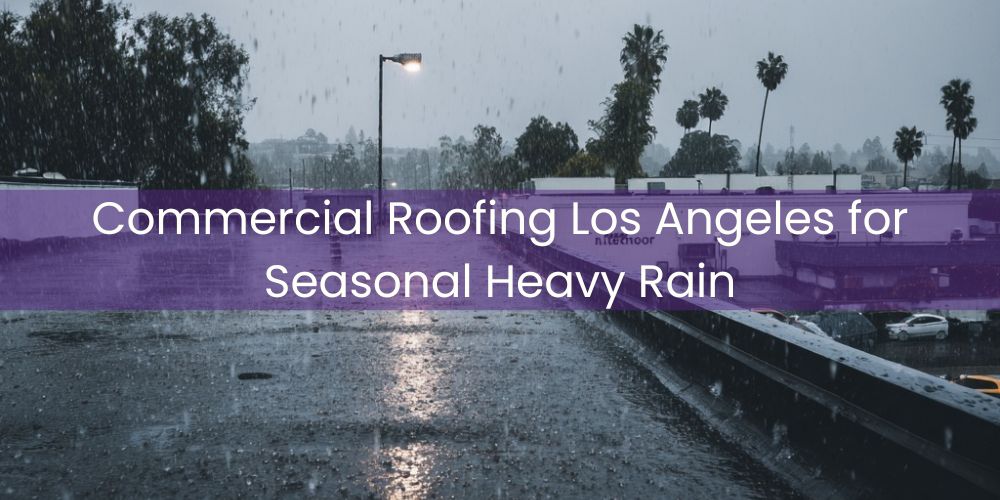
Commercial Roofing Los Angeles designs commercial roofing systems across Los Angeles to protect commercial buildings from water-driven roof failure caused by seasonal heavy rain events. In Southern California’s climate, commercial roofs experience long dry periods followed by episodic, high-intensity rainfall that rapidly introduces large volumes of water onto low-slope roof assemblies. These conditions place concentrated hydraulic stress on membranes, seams, flashings, drains, and penetrations, creating the underlying vulnerabilities that lead to leaks and roof system failure if not addressed at the design level. Commercial Roofing Los Angeles engineers roof systems specifically to perform during high-volume rain events without losing waterproofing continuity or structural stability. By selecting materials, drainage capacity, slope configuration, and assembly methods that manage water accumulation rate, dwell time, and discharge, we design roofs that maintain integrity during storm conditions. These systems allow commercial buildings to remain watertight, operational, and financially protected during Los Angeles seasonal rain events year after year.
How Do Commercial Roof Designs Protect Los Angeles Buildings From Seasonal Heavy Rain?
Los Angeles commercial roofs operate under a rainfall pattern defined by infrequent but concentrated storm events, where large volumes of water are delivered over short periods following extended dry conditions. During these storms, water rapidly accumulates on low-slope roof surfaces, increasing dwell time and hydraulic head at seams, flashings, drains, and penetrations. On the concrete, steel, and wood-framed commercial buildings common throughout Los Angeles, this sudden water loading exposes weaknesses at roof interfaces where separation or degradation has developed during dry months. We design commercial roofing systems for Los Angeles because controlling how stormwater enters, moves across, and exits the roof assembly is the only way to prevent rain-driven failure. Drainage systems are engineered to remove water faster than it accumulates, while membranes and seams are selected to remain watertight under sustained ponding. Flashings and penetrations are detailed to resist elevated water head so moisture cannot migrate beneath the roof surface during storm cycles. Commercial Roofing Los Angeles engineers roof assemblies to manage the cumulative effects of water volume, ponding duration, and hydraulic pressure that define Los Angeles roof performance during seasonal rain events. By controlling water flow, limiting surface dwell time, and stabilizing critical interfaces, rain-driven stress is prevented from progressing into active leak pathways. This system-level approach is what allows commercial roofs in Los Angeles to withstand seasonal heavy rain without premature failure, keeping buildings dry, protected, and operational throughout their service life.
How Do Seasonal Heavy Rain Events Create Leak Pathways on Los Angeles Commercial Roofs?
Seasonal heavy rain events in Los Angeles place acute hydraulic stress on commercial roof assemblies by rapidly introducing large volumes of water onto low-slope roof surfaces following extended dry periods. During these storms, water accumulates faster than it can discharge, increasing dwell time and hydrostatic pressure at seams, flashings, drains, and penetrations. On the concrete, steel, and wood-framed commercial buildings common throughout Los Angeles, this sudden water loading exploits separation and degradation that developed during dry months, allowing moisture to enter the roof system and migrate beneath the membrane. Commercial Roofing Los Angeles designs commercial roofing systems in Los Angeles to manage how stormwater interacts with roof assemblies rather than reacting after leaks occur. Roof systems are engineered so water is removed efficiently, ponding duration is limited, and hydraulic pressure does not force moisture laterally beneath membranes. This design-for-rain approach prevents seasonal storms from converting latent weaknesses into active leak pathways that lead to insulation saturation and progressive roof failure.
Rain-resistant roof assemblies perform in Los Angeles because drainage design, membrane selection, and interface detailing are engineered to control water accumulation, pressure, and movement across the roof surface; this interaction can be reduced to direct cause-and-effect relationships below.
- Prolonged surface ponding → elevated hydraulic head at seams → lateral moisture migration beneath the membrane
- Restricted drainage paths → increased water dwell time → insulation saturation before interior leaks appear
- Penetrations and flashings under water head → interface separation → direct moisture entry into the roof assembly
- Ponding-tolerant membranes → sustained wetting without degradation → waterproofing continuity maintained
- Engineered drainage capacity → water removed faster than accumulation → rain does not activate leak pathways
Have a question about an upcoming project?
Where Is Seasonal Heavy Rain Stress Concentrated on Los Angeles Commercial Roofs?
Commercial Roofing Los Angeles identifies seasonal heavy rain stress on Los Angeles commercial rooftops as concentrating at locations where water dwell time increases and where roof assemblies interrupt or restrain water flow. On low-slope commercial buildings, intense storm events following long dry periods cause rapid surface saturation and ponding, concentrating hydraulic pressure at seams, flashings, drains, penetrations, and perimeter transitions rather than across uninterrupted membrane fields. Seams and flashing transitions experience the highest rain-related stress because they interrupt otherwise continuous waterproofing surfaces and are exposed to prolonged wetting during storm cycles. As water accumulates on the roof surface, hydraulic head increases at these interfaces, forcing moisture against bonded seams and flashing terminations. Over time, sustained pressure and repeated wetting weaken seam bonds and flashing adhesion, allowing separation to form. Once separation occurs, rainwater migrates laterally beneath the membrane, spreading moisture beyond the original entry point before interior leaks become visible. Drain locations and their surrounding roof areas are another primary concentration zone during seasonal heavy rain events. When rainfall intensity exceeds drainage capacity, water dwell time increases around drains, raising localized hydrostatic pressure. This prolonged ponding accelerates moisture intrusion at drain interfaces and surrounding seams, allowing water to bypass the membrane surface and saturate insulation layers below. Roof penetrations and equipment curbs, particularly around rooftop HVAC units, further intensify rain stress due to rigid framing combined with elevated water head during storm events. As water pools against curbs and penetrations, pressure concentrates at sealant joints and flashing transitions. Without detailing that resists sustained wetting and elevated hydraulic load, sealants degrade, flashings pull away, and gaps open that allow direct moisture entry into the roof assembly. Seasonal heavy rain stress concentrates at these locations because water movement is constrained rather than rapidly discharged. Roof assemblies that fail to shed water efficiently at seams, drains, and penetrations allow hydraulic pressure to translate directly into separation, moisture entry, and progressive system failure.
In Los Angeles, seasonal heavy rain creates predictable failure paths at seams, drains, and penetrations; these failure paths can be reduced to direct cause-and-effect relationships between water dwell time, hydraulic pressure, and moisture migration below.
- Prolonged ponding at seams → elevated hydraulic head → lateral moisture migration beneath the membrane
- Restricted drainage capacity → increased water dwell time → insulation saturation before visible leaks
- Water head at penetrations and curbs → interface separation → direct moisture entry into the roof assembly
When Do Seasonal Heavy Rain Events Require Professional Roofing Intervention in Los Angeles?
Seasonal heavy rain events require professional roofing intervention on Los Angeles commercial roofs when stormwater accumulation has begun to overwhelm drainage capacity and exploit weaknesses at seams, penetrations, flashings, or drains, but the roof deck and insulation remain structurally serviceable. On low-slope commercial buildings, early indicators include recurring ponding after rainstorms, intermittent leaks following heavy rainfall, moisture appearing around drains or penetrations, or staining that coincides with storm events rather than constant leakage. These conditions signal that rain-driven hydraulic pressure and extended water dwell time are no longer being safely managed by the roof assembly. Under Los Angeles climate conditions, where infrequent but high-intensity storms deliver large water volumes over short periods, intervention is appropriate when water intrusion is confined to surface interfaces and attachment points rather than full insulation saturation or deck deterioration. Commercial Roofing Los Angeles evaluates drainage performance, ponding duration, seam and flashing integrity, penetration detailing, and subsurface moisture conditions to determine whether targeted corrective work can arrest rain-driven failure progression. When addressed at this stage, professional intervention restores drainage function, prevents lateral moisture migration, and delays the need for full roof replacement under ongoing seasonal rain stress.