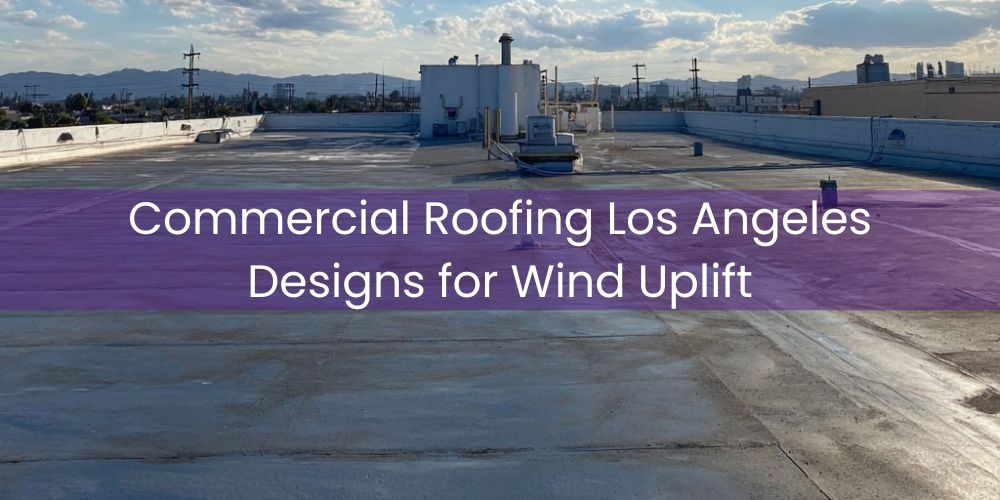
Commercial Roofing Los Angeles designs commercial roofing systems across Los Angeles specifically to protect business-owned buildings from wind uplift and pressure forces that act on low-slope commercial roof assemblies. In Los Angeles, commercial roofs are routinely subjected to sustained and gust-driven wind conditions produced by coastal weather systems, Santa Ana wind events, and localized pressure differentials around large commercial structures. These conditions generate negative pressure at roof edges, corners, and perimeters while internal building pressure simultaneously pushes upward against the roof assembly through doors, loading bays, windows, and ventilation openings. When wind uplift and pressure forces are not controlled at the design level, they progressively loosen mechanical fasteners, fatigue attachment points, separate seams, and destabilize perimeter edge systems. Over time, this mechanical degradation leads directly to membrane detachment, loss of waterproofing continuity, and rapid water intrusion during routine wind events. Commercial Roofing Los Angeles designs roof assemblies to control wind uplift and pressure forces at the system level so mechanical stability is preserved under repeated wind loading. Roof designs are engineered around how uplift and pressure forces are transferred through membranes, fasteners, insulation, decks, and perimeter details. Attachment strategies, fastening densities, and edge securement systems are specified to resist negative pressure and cyclic uplift without progressive loosening. By integrating load transfer paths across the full roof assembly, wind forces are directed into the structural deck and framing rather than concentrating at vulnerable surface components. Design focus is placed on the roof components most exposed to wind forces. Edges, corners, seams, fasteners, penetrations, and perimeter terminations experience the highest uplift pressures and pressure cycling on commercial buildings. These components are detailed to remain mechanically secured and watertight so wind uplift and pressure forces cannot compromise the building envelope.
How Does Los Angeles Building Stock Shape Roofing Decisions for Business Owners?
Los Angeles’s commercial building stock directly determines how roofs must be designed to resist wind uplift and pressure forces. Many commercial properties in the region are low-slope concrete, steel, or wood-framed structures with large roof spans, exposed perimeters, rooftop mechanical equipment, and wide façades that intensify wind pressure effects. These buildings experience concentrated uplift forces at corners and edges, placing continuous mechanical stress on fasteners, seams, edge systems, and attachment points. Without roof assemblies designed to resist these forces, wind pressure causes progressive loosening that leads to membrane separation and water entry. To manage these risks, roof designs incorporate pressure-rated attachment patterns and reinforced assemblies capable of resisting uplift without mechanical failure. Engineered perimeter systems stabilize edges and corners where wind forces concentrate most severely. Deck attachment and load transfer are equally critical. Properly secured decks ensure wind loads are transferred into the structural framing rather than absorbed by surface components, preventing stress concentration and extending roof service life. Drainage and detailing complete the system. Los Angeles commercial roofs must remain mechanically secure while shedding wind-driven rain without allowing pressure-induced weaknesses to activate. Edge conditions, penetrations, fasteners, and interfaces are designed to remain stable and watertight during wind events. This system-level design approach ensures commercial roofs remain structurally stable and resistant to wind uplift and pressure forces under Los Angeles conditions.
How Do Wind Uplift and Pressure Forces Create Failure Pathways on Los Angeles Commercial Roofs?
Wind uplift and pressure forces create failure pathways on Los Angeles commercial roofs by inducing mechanical separation at the components responsible for structural attachment and waterproofing continuity. Sustained winds and gust-driven pressure differentials generate negative pressure at roof edges, corners, and perimeters while internal building pressure simultaneously pushes upward against the roof assembly. This opposing force acts repeatedly on membranes, fasteners, seams, edge systems, and penetrations, stressing attachment points and bonded interfaces. On the low-slope concrete, steel, and wood-framed commercial buildings common throughout Los Angeles, this stress does not typically cause immediate failure but gradually loosens fasteners, fatigues seams, and weakens perimeter securement. Over time, these mechanically stressed interfaces develop latent separation zones that become active failure pathways during routine wind events or wind-driven rain. Commercial Roofing Los Angeles designs commercial roofing systems for Los Angeles because preventing wind-induced mechanical separation at attachment points and interfaces is the only way to stop this failure mechanism. Roof assemblies are engineered to resist negative pressure and cyclic uplift so mechanical loads are transferred safely into the structural deck and framing rather than concentrating at surface components. Fastener densities, attachment patterns, and edge securement systems are specified to prevent progressive loosening under repeated wind loading. Seam and perimeter details are designed to maintain mechanical restraint and waterproofing continuity as wind forces cycle across the roof surface. Penetrations and transitions are reinforced to resist uplift forces that can otherwise create direct openings for moisture intrusion once separation begins.
The wind-driven failure pathway mechanisms described above can be expressed as direct cause-and-effect relationships between pressure forces, mechanical separation, and moisture intrusion below.
- Wind uplift at edges and corners → fastener fatigue and loosening → perimeter separation
- Negative pressure cycling → seam movement and attachment stress → loss of waterproofing continuity
- Internal pressurization → upward force on roof assembly → membrane detachment risk
- Edge system instability → localized blow-off initiation → progressive roof failure
- Pressure-rated attachment and detailing → stabilized interfaces → failure pathways do not form
Have a question about an upcoming project?
Where Does Wind-Driven Mechanical Stress Concentrate on Los Angeles Commercial Roofs?
Commercial roofing systems on buildings in Los Angeles experience wind-driven mechanical stress as a pressure-induced load that concentrates at roof locations where uplift forces, attachment transitions, and perimeter conditions intersect. Sustained winds and gust-driven pressure differentials generate the highest negative pressure at roof edges, corners, and perimeters rather than across uninterrupted roof fields. These zones experience repeated uplift cycling as wind accelerates over building edges, placing continuous mechanical stress on membranes, fasteners, seams, and edge systems. Because these components rely on mechanical restraint rather than material continuity alone, wind forces concentrate where attachment density changes or where assemblies terminate. Over time, this stress causes progressive loosening and micro-movement that develops into latent separation zones. Perimeter edge systems and corner zones experience the highest concentration of wind-driven stress because they are exposed to the strongest uplift pressures and pressure gradients. Edge metal, coping systems, and perimeter fasteners are repeatedly loaded as wind pressure fluctuates, increasing fatigue at attachment points. As mechanical restraint weakens, localized separation begins at the perimeter and migrates inward under subsequent wind events. Once separation occurs, these locations become initiation points for membrane detachment and water intrusion during wind-driven rain. Fasteners and attachment points across the roof field form a second major concentration zone for wind-driven stress. Cyclic uplift forces act directly on fastener heads, plates, and anchor points, gradually reducing clamping force through fatigue and micro-movement. As fasteners loosen, surrounding materials experience increased stress, enlarging openings that allow wind pressure and moisture to bypass the membrane surface and enter the roof assembly. This process accelerates insulation displacement and localized deck stress once separation begins. Roof penetrations and rooftop equipment curbs further intensify wind-driven mechanical stress due to abrupt changes in geometry and rigid framing. Wind flow disruption around penetrations increases localized pressure, placing uplift forces on curb flashings and transition details. Because penetrations interrupt otherwise continuous attachment patterns, mechanical separation at these locations creates direct pathways for air and moisture intrusion once restraint is compromised. Wind-driven mechanical stress concentrates at these locations because uplift forces accumulate where roof assemblies change direction, terminate, or rely on discrete attachment points. Roof systems that do not control uplift stress at edges, fasteners, and penetrations allow mechanical separation to progress into membrane detachment, water entry, and progressive roof system failure.
The concentration patterns described above can be reduced to explicit cause-and-effect relationships between wind pressure loading, mechanical stress concentration, and failure initiation points within the roof assembly.
- Wind uplift at roof edges → fastener fatigue → perimeter separation
- Corner pressure amplification → edge system instability → blow-off initiation
- Cyclic uplift at fasteners → loss of clamping force → membrane movement
- Pressure concentration at penetrations → flashing separation → direct water entry
When Do Wind Uplift and Pressure Forces Require Professional Roofing Intervention in Los Angeles?
Wind uplift and pressure forces require professional roofing intervention on Los Angeles commercial roofs when mechanical attachment and perimeter restraint have begun to degrade, but the roof deck and insulation remain structurally serviceable. On low-slope commercial buildings in Los Angeles, early indicators include loosened or missing fasteners, displaced edge metal, membrane flutter during wind events, separation at seams or perimeter transitions, or leaks that appear after high-wind conditions rather than during prolonged rainfall. These conditions signal that wind-induced pressure cycling is no longer being safely transferred through the roof assembly and is beginning to convert mechanical stress into active failure pathways. Under Los Angeles wind conditions, where sustained winds and gust-driven pressure differentials repeatedly load roof edges, corners, and penetrations, intervention is appropriate when separation is confined to attachment points, seams, and perimeter systems rather than widespread membrane detachment or deck damage. Commercial Roofing Los Angeles evaluates fastener securement, edge system stability, seam integrity, penetration detailing, and subsurface movement to determine whether targeted corrective work can arrest wind-driven failure progression. When addressed at this stage, professional intervention restores mechanical restraint, stabilizes vulnerable interfaces, and prevents progressive uplift, water intrusion, and emergency roof failure under ongoing wind exposure.