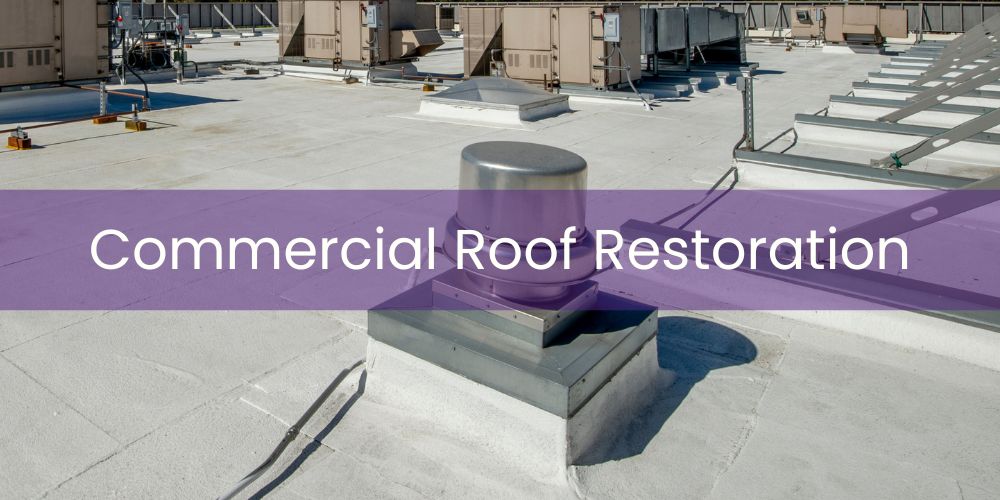
Commercial Roofing Los Angeles performs commercial roof restoration across Los Angeles to stop active leaks, reverse surface deterioration, and extend the service life of aging commercial roofing systems exposed to extreme sun and moisture stress. Commercial roof restoration is the process of repairing, sealing, and recoating an existing roof to recover waterproofing, thermal performance, and structural stability without removing the entire system. This work allows Commercial Roofing Los Angeles to stabilize roofs that have suffered UV damage, seam fatigue, and surface cracking while avoiding the disruption and cost of full replacement. Roof restoration is used on Los Angeles commercial buildings where heat, solar exposure, and standing water have degraded the roof surface but the underlying structure remains sound. By sealing weaknesses and reinforcing the roof surface, restoration prevents moisture from penetrating insulation and deck layers. Commercial Roofing Los Angeles restores commercial roofs to keep buildings watertight, energy-efficient, and protected under Southern California’s climate.
How Does Commercial Roof Restoration Stop Heat-Driven Leaks and System Breakdown on Los Angeles Roofs?
Los Angeles commercial roofs begin to fail when heat and ultraviolet radiation break down the surface of the roofing system. Daily thermal expansion and contraction dry out membranes, weaken seams, and create small cracks that allow water to enter. Once moisture penetrates the roof surface, it spreads laterally across insulation layers, reducing thermal resistance and creating hidden leak paths that grow with every heat cycle. Commercial Roofing Los Angeles stops this failure process through commercial roof restoration that seals and re-stabilizes the existing roof system. Damaged seams, cracks, and penetrations are repaired, and a new protective coating or membrane layer is applied to create a continuous, watertight surface. This restored barrier blocks UV exposure, limits temperature swings, and prevents moisture from migrating beneath the roof. Restoration systems installed by Commercial Roofing Los Angeles remain flexible under extreme heat while maintaining strong adhesion to the existing roof assembly. This allows the roof to move with Southern California’s temperature changes without reopening cracks or seams. The result is a stabilized commercial roofing system that resists UV degradation, blocks water intrusion, and preserves the structural and thermal integrity of Los Angeles commercial buildings.
What Is Commercial Roof Restoration and How Is It Used in Los Angeles?
Commercial roof restoration is a service that renews an existing commercial roofing system by repairing defects, reinforcing critical components, and applying a restorative membrane to extend service life without removing the full roof assembly. The service is defined by substrate preparation, localized repairs, and system-wide surface restoration rather than complete tear-off. Restoration is performed only when the roof deck, insulation, and primary structure remain serviceable. In Los Angeles, Commercial Roofing Los Angeles performs commercial roof restoration on warehouses, office buildings, retail centers, and industrial properties where roofs have experienced surface degradation from sustained radiative stress, thermal cycling, and intermittent moisture exposure. Restoration is used when heat and ultraviolet exposure have aged membranes, seams, and protective surfaces, but replacement is not structurally or economically required. Systems are restored to align with Southern California roof geometries, drainage behavior, and movement patterns.
The restoration methods and system decisions that allow commercial roof restoration to perform in Los Angeles create the following performance relationships:
- Surface defect remediation → restores material continuity → existing cracks do not propagate
- Seam and penetration reinforcement → stabilizes interface zones → thermal cycling does not reopen failure points
- Fluid-applied restorative membrane → creates continuous waterproof field → hydrological exposure cannot enter the system
- Elastomeric membrane properties → accommodate thermal cycling → expansion and contraction do not fracture the surface
- High-reflectivity surface restoration → reduces radiative stress → heat does not accelerate material degradation
- Adhered restoration interface → locks membrane to substrate → wind forces do not lift restored areas
- Encapsulation of existing materials → isolates aging components → underlying membranes do not release moisture
Have a question about an upcoming project?
Where Does Commercial Roof Restoration Re-Stabilize Heat, Moisture, and Movement Stress on Los Angeles Roofs?
We perform commercial roof restoration on Los Angeles buildings where failure is concentrated at the roof surface rather than embedded throughout the entire assembly. Sustained solar exposure, daily thermal cycling, and intermittent moisture degrade membranes, seams, and protective layers, allowing small surface openings to form even though the deck and insulation remain structurally viable. Roof restoration targets these stress zones by repairing discontinuities and applying a continuous restorative layer that absorbs thermal movement and blocks moisture before it can enter the roof system. On flat commercial roofs, surface degradation is often most severe around seams, penetrations, drains, and transition points where heat, water, and movement converge. Restoration reinforces these interfaces so repaired seams and penetrations remain sealed as temperatures rise and fall. The restored surface prevents rainwater and condensation from exploiting weakened areas and migrating laterally through insulation, which is the primary mechanism by which aging roofs develop widespread leaks under Los Angeles conditions. Long-term exposure to Southern California heat also affects how restored roofs behave over time. Restorative membranes and coatings maintain elasticity and adhesion under high surface temperatures, allowing expansion and contraction to occur at the restored layer rather than reopening cracks in the underlying roof. By re-establishing surface continuity and stabilizing how heat and moisture interact with the roof, commercial roof restoration extends service life while preventing surface-level degradation from progressing into system-wide failure.
In practice, commercial roof restoration performance on Los Angeles buildings can be reduced to direct cause-and-effect relationships between restorative actions, localized stressors, and renewed roof stability.
- Surface crack repair → thermal cycling → openings do not propagate
- Seam and penetration reinforcement → movement and heat stress → interfaces remain sealed
- Restorative membrane application → rainfall and condensation → moisture does not migrate beneath the surface
- Elastomeric restoration layer → daily expansion and contraction → surface does not fracture
- Reflective surface renewal → sustained solar exposure → heat-driven degradation is slowed
When Do Los Angeles Commercial Roofs Qualify for Professional Restoration?
If your Los Angeles commercial roof is experiencing surface deterioration, recurring minor leaks, or heat-related wear—but the underlying structure and insulation remain serviceable—professional roof restoration may be the appropriate solution. Under constant sun exposure, thermal cycling, and periodic ponding, weakened membranes, fatigued seams, and degraded coatings allow moisture and heat to accelerate surface breakdown without yet requiring full system replacement. Commercial roof restoration is used to recover waterproofing continuity, improve thermal performance, and extend roof service life by reinforcing and sealing the existing system rather than removing it. If your building is dealing with UV-damaged surfaces, seam fatigue, coating failure, or rising cooling demand—but does not have widespread insulation saturation or structural failure—roof restoration can stabilize the system and delay replacement under Los Angeles conditions.