
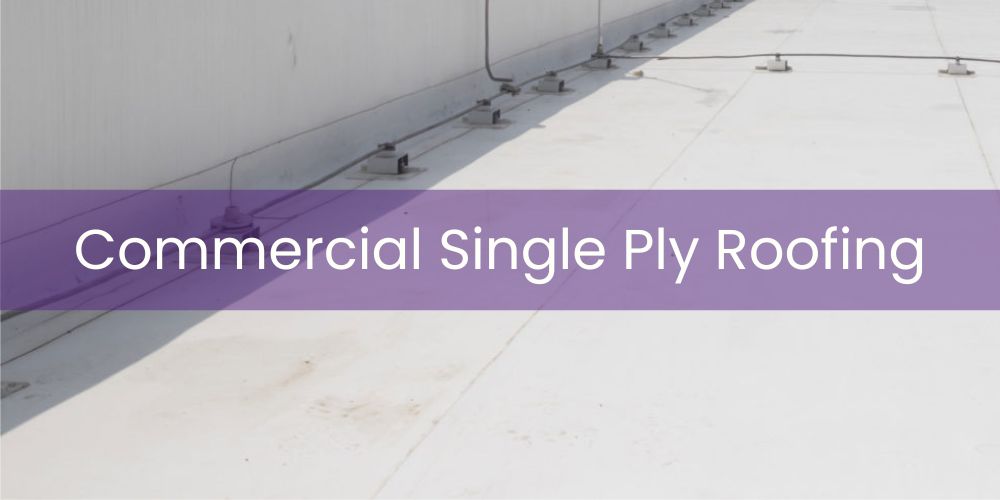
Commercial Roofing Los Angeles installs commercial single-ply roofing across Los Angeles to stop water intrusion, control heat stress, and protect flat commercial buildings from membrane failure. Commercial single-ply roofing is a system category defined by the use of factory-manufactured sheet membranes installed as a continuous waterproof layer over commercial roof decks. This category includes thermoplastic and elastomeric membranes such as TPO, PVC, and EPDM, which differ in chemical composition but share common system behaviors when designed and installed as single-ply assemblies. This system allows Commercial Roofing Los Angeles to keep commercial roofs watertight, thermally stable, and structurally protected under Southern California’s intense sun and temperature cycling. Single-ply roofing is used on Los Angeles commercial buildings where flat roof geometry, rooftop equipment, and daily heat expansion have caused seams, flashings, and older membranes to crack or separate. By forming a sealed, flexible, and UV-resistant roof surface, single-ply systems prevent water and heat from degrading insulation, deck materials, and interior spaces. Commercial Roofing Los Angeles installs single-ply roofing systems to preserve waterproofing, reduce energy loss, and maintain building performance across Los Angeles. While TPO, PVC, and EPDM differ in chemistry, weldability, and long-term aging characteristics, the performance relationships described here apply to properly designed single-ply systems where membrane selection, seam method, attachment strategy, and detailing are engineered to work together as a unified waterproofing system.
How Does Commercial Single-Ply Roofing Stop Heat-Driven Leaks and Membrane Separation on Los Angeles Roofs?
Los Angeles commercial roofs fail because heat and movement pull roofing systems apart. Intense solar radiation heats flat roof surfaces every day, causing membranes to expand, while cooler nights force them to contract. On large commercial buildings, this constant thermal cycling places stress on seams, penetrations, and attachment points. As materials fatigue, small gaps open, allowing rainwater and condensation to slip beneath the membrane and migrate laterally through insulation and deck layers, creating leaks far from where the failure began. Commercial Roofing Los Angeles prevents this failure by installing single-ply roofing systems that maintain continuous waterproofing while allowing controlled movement. Single-ply membranes are heat-welded or chemically bonded into a seamless sheet that resists separation under thermal stress. Flashings, penetrations, and edges are integrated into the same membrane system so water cannot find a path beneath the roof surface. The membranes also reflect solar radiation and resist ultraviolet breakdown, slowing the aging process that leads to cracking and brittleness. Single-ply roofing systems installed by Commercial Roofing Los Angeles are engineered to remain flexible under extreme temperature swings while staying securely attached to the roof deck. This allows the roof to move with the building as heat loads rise and fall without opening seams or creating new leak paths. The result is a commercial roofing system that blocks moisture migration, resists UV and heat damage, and preserves the waterproofing and structural integrity of Los Angeles commercial buildings.
What Is Single-Ply Roofing and How Is It Used in Los Angeles?
Single-ply roofing is a commercial roofing system defined by the installation of a single, continuous sheet membrane over insulation and structural roof decks to create a unified waterproof barrier. The system category includes thermoplastic and elastomeric membranes installed as large-format sheets with bonded, welded, or mechanically secured seams. Single-ply roofing systems are characterized by low material mass, flexible behavior, and engineered seam connections rather than layered redundancy. In Los Angeles, Commercial Roofing Los Angeles installs single-ply roofing on warehouses, office buildings, retail centers, logistics facilities, and industrial properties where roofs are exposed to sustained radiative stress, thermal cycling, and structural movement. Single-ply systems are used on flat and low-slope roofs where wide spans, rooftop equipment, and daily heat expansion place stress on rigid assemblies. System selection and attachment methods are engineered to align with Southern California roof geometry, drainage behavior, and movement patterns.
The shared system-level design and assembly decisions common to properly engineered single-ply roofing systems in Los Angeles create the following performance relationships:
- Continuous sheet membrane → creates uninterrupted waterproof field → hydrological exposure cannot enter the assembly
- Engineered seam bonding or welding → forms monolithic joints → thermal cycling does not separate connections
- Low membrane mass → responds quickly to temperature change → thermal stress does not accumulate in the system
- Flexible membrane composition → accommodates structural movement → vibration does not fracture the roofing surface
- High solar reflectivity (system-dependent) → reduces radiative stress → surface temperatures do not accelerate degradation
- Mechanically secured or adhered attachment → stabilizes membrane position → wind uplift does not displace roofing
- Smooth membrane surface → promotes water flow → intermittent rainfall does not pond and infiltrate the system
- Reinforced flashing assemblies → stabilize penetration interfaces → rooftop equipment does not become leak paths
Have a question about an upcoming project?
Where Does Single-Ply Roofing Absorb Thermal Movement and Prevent Water Entry on Los Angeles Commercial Roofs?
We install single-ply roofing on Los Angeles commercial buildings where heat, movement, and water concentrate stress at seams, penetrations, edges, and equipment zones rather than across the roof field evenly. Daily solar loading heats wide flat roofs and forces membranes to expand, while nighttime cooling contracts them, placing repeated stress on seam lines, flashing transitions, and attachment points. When we install single-ply systems, the membrane is welded or bonded into a continuous waterproof layer so this movement is absorbed within the sheet instead of pulling joints apart and opening paths for water to enter insulation and deck layers. We design each single-ply installation around how Los Angeles roofs are actually used and loaded. Rooftop HVAC units, service walk paths, pipe penetrations, and perimeter edges experience vibration, foot traffic, and accelerated thermal cycling. We integrate flashings, penetrations, and edge details into the same membrane plane so movement remains continuous across the system. By maintaining seam integrity, controlled attachment, and surface reflectivity, the membrane resists UV degradation and prevents heat-driven fatigue from turning localized stress into lateral leaks.
The performance of single-ply roofing on Los Angeles commercial buildings can be reduced to direct cause-and-effect relationships between membrane behavior, local stressors, and roof system outcomes:
- Continuous single-ply membrane → flat-roof hydrological exposure → water does not enter the roof assembly
- Heat-welded or bonded seams → daily thermal cycling → joints do not separate into leak paths
- Flexible membrane composition → structural movement and vibration → surface does not crack or tear
- Integrated flashing systems → penetration movement → interfaces remain watertight
- Reflective membrane surface → sustained solar radiation → heat does not accelerate membrane aging
- Engineered attachment methods → wind uplift and expansion forces → membrane position remains stable
When Do Single-Ply Roofing Systems Become the Correct Solution in Los Angeles?
If your Los Angeles commercial building has a flat or low-slope roof where heat, movement, and rooftop equipment are stressing seams and penetrations, a properly engineered single-ply system may be required to restore continuous waterproofing. Under constant solar exposure and daily expansion and contraction, older or fragmented roof assemblies allow seams to separate, flashings to fatigue, and moisture to migrate laterally through insulation and deck layers long before leaks are obvious inside. We evaluate whether your roof’s failure patterns are best addressed with a unified single-ply system—or if existing conditions require a different approach—based on how the roof is actually performing under Los Angeles heat, movement, and drainage behavior. If you’re dealing with recurring seam leaks, membrane separation, UV-driven aging, or inconsistent roof performance across the building, we can determine whether a correctly designed single-ply system will stabilize the roof or if alternative system strategies are required.