
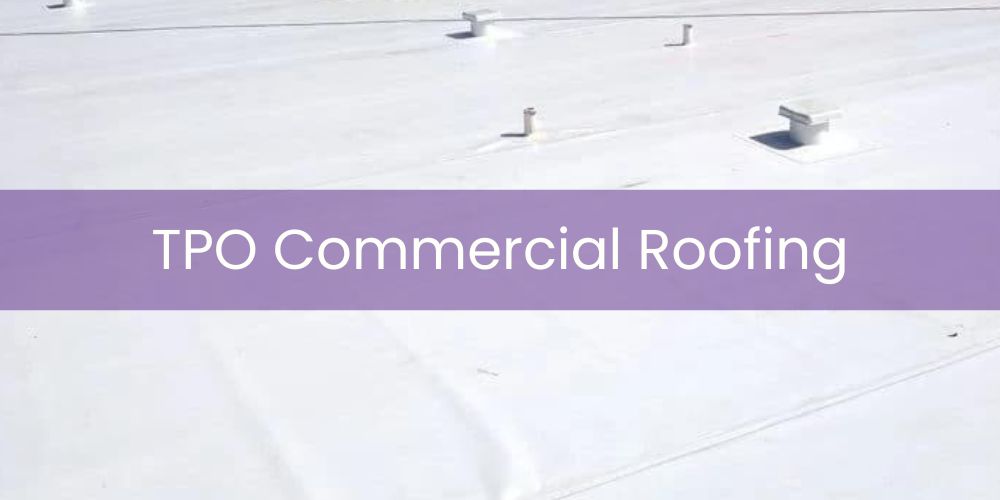
Commercial Roofing Los Angeles installs TPO commercial roofing across Los Angeles to reflect heat, block water intrusion, and stabilize flat roofing systems exposed to extreme sun and thermal stress. TPO commercial roofing is the process of installing thermoplastic single-ply membranes with heat-welded seams over commercial roof decks to create a reflective, watertight, and UV-resistant roofing system. This allows Commercial Roofing Los Angeles to control rooftop temperatures, prevent seam separation, and protect insulation and structural components beneath the membrane. TPO roofing is used on Los Angeles commercial buildings where intense solar exposure, daily temperature swings, and rooftop equipment have degraded older roofing systems and allowed moisture to penetrate into insulation and deck layers. By forming a continuously welded surface, TPO roofing prevents heat-driven expansion and contraction from opening leak paths and allows water to drain without entering the roof assembly. Commercial Roofing Los Angeles installs TPO roofing systems to keep commercial buildings thermally efficient, watertight, and structurally protected under Southern California’s climate.
How Does TPO Commercial Roofing Stop Heat-Driven Seam Failure and Water Migration in Los Angeles?
Los Angeles commercial roofs fail because heat and movement pull roofing seams apart. During the day, solar radiation heats roof surfaces, causing membranes to expand, while cooler nights force them to contract. This constant thermal cycling stresses seams, penetrations, and flashing details, eventually creating openings where rain and condensation enter the roofing system. Once moisture reaches insulation layers, it spreads laterally beneath the membrane, reducing thermal performance and causing leaks to appear far from the original breach. Commercial Roofing Los Angeles stops this failure process by installing TPO roofing systems with heat-welded seams that fuse into a single continuous membrane. These welded seams resist thermal movement and prevent separation, eliminating the pathways water uses to migrate beneath the roof surface. The reflective surface of TPO reduces rooftop temperatures, limiting expansion and slowing material fatigue. TPO systems installed by Commercial Roofing Los Angeles are engineered to remain stable under Southern California heat while maintaining strong seam integrity and waterproofing. This allows the roof to move with temperature changes without opening leaks, preserving insulation performance and protecting the structural integrity of Los Angeles commercial buildings year after year.
What Is TPO Roofing and How Is It Used in Los Angeles?
TPO roofing is a single-ply commercial roofing system composed of thermoplastic polyolefin membranes installed as a continuous waterproof layer over insulation and structural roof decks. The system is defined by heat-welded seams, reinforced sheet construction, and thermoplastic material behavior rather than layered mass or rigid panels. TPO membranes are installed using fully adhered, mechanically attached, or induction-welded attachment methods depending on roof design and structural requirements. In Los Angeles, Commercial Roofing Los Angeles installs TPO roofing on warehouses, office buildings, retail centers, logistics facilities, and industrial properties where roofs are exposed to sustained radiative stress, thermal cycling, and rooftop equipment activity. TPO systems are selected for flat and low-slope roofs where high solar exposure and daily temperature swings place continuous stress on roofing materials. Assemblies are engineered to align with Southern California roof geometry, drainage behavior, and movement patterns.
The material and assembly decisions that allow TPO roofing to perform in Los Angeles create the following performance relationships:
- Thermoplastic TPO membrane → enables heat-welded seam fusion → hydrological exposure cannot penetrate joints
- Reinforced membrane scrim → limits dimensional movement → thermal cycling does not distort the sheet
- High solar reflectivity → reduces radiative stress → surface temperatures do not accelerate material aging
- Flexible thermoplastic composition → accommodates thermal cycling → expansion and contraction do not crack the membrane
- Mechanically secured or adhered attachment → stabilizes membrane position → wind uplift does not displace roofing
- Continuous sheet installation → minimizes field seams → water cannot migrate between membrane sections
- Smooth membrane surface → promotes drainage flow → intermittent rainfall does not pond and infiltrate the system
- Reinforced flashing assemblies → stabilize penetration interfaces → rooftop equipment does not become leak paths
Have a question about an upcoming project?
Where Does TPO Commercial Roofing Absorb Solar Load and Thermal Movement on Los Angeles Buildings?
We install TPO commercial roofing on Los Angeles buildings where heat-driven stress concentrates at specific roof components rather than distributing evenly across the field. Flat roof geometry, long daylight exposure, and wide roof spans cause thermal expansion to focus at seams, penetrations, drains, perimeter edges, and transitions around rooftop equipment. These zones experience the highest daily movement as membrane temperatures rise under solar load and contract after sunset. On systems without welded continuity, stress accumulates at these points until seams fatigue and openings form that allow water to enter insulation and spread laterally across the deck. Commercial Roofing Los Angeles installs TPO systems so thermal movement is absorbed at the membrane plane instead of being transferred into seams, fasteners, or substrate interfaces. Heat-welded seams fuse adjacent sheets into a single continuous waterproof field, allowing expansion and contraction to occur uniformly across the roof surface. At penetrations, curbs, and drains, we integrate reinforced flashings into the same welded system so movement does not isolate weak points where water can enter. On buildings with dense rooftop equipment and long uninterrupted spans, attachment patterns and insulation interfaces are detailed to stabilize the membrane while still allowing controlled movement under Los Angeles heat loads. By controlling where stress is absorbed, TPO roofing prevents localized thermal movement from becoming moisture migration inside the roof assembly. Seams remain locked, drainage paths stay open, and insulation remains dry even under repeated solar loading and daily temperature cycling. This allows Los Angeles commercial roofs to remain watertight and structurally stable despite prolonged sun exposure and continuous expansion–contraction cycles.
These Los Angeles-specific stress concentrations create direct cause-and-effect performance outcomes:
- Heat-welded TPO seams → daily thermal expansion and contraction → membrane joints do not separate
- Reflective membrane surface → sustained solar load → rooftop temperatures remain controlled
- Reinforced flashing assemblies → movement at penetrations → leak paths do not form
- Continuous welded membrane field → lateral water pressure → moisture cannot migrate beneath the surface
- Engineered attachment patterns → wind uplift and thermal movement → membrane position remains stable
When Does TPO Roofing Become the Correct Solution in Los Angeles?
If your Los Angeles commercial building requires a reflective, heat-welded roofing system to manage extreme solar exposure and maintain long-term seam integrity, TPO roofing may be the correct replacement solution. Under Southern California’s intense sun and daily temperature swings, older membranes, mechanically fastened systems, and non-welded assemblies fatigue, separate, and absorb heat, accelerating membrane aging and moisture migration. TPO roofing is engineered with thermoplastic, heat-welded seams and high solar reflectivity to control rooftop temperatures and maintain continuous waterproofing across large flat roof areas. It is most appropriate where heat load, seam durability, and energy performance are primary concerns rather than ponding water or heavy mechanical abuse. If your building is planning a roof replacement, experiencing excessive rooftop heat, or needs a welded membrane system designed to perform reliably under Los Angeles climate conditions, TPO roofing may be the appropriate system choice.