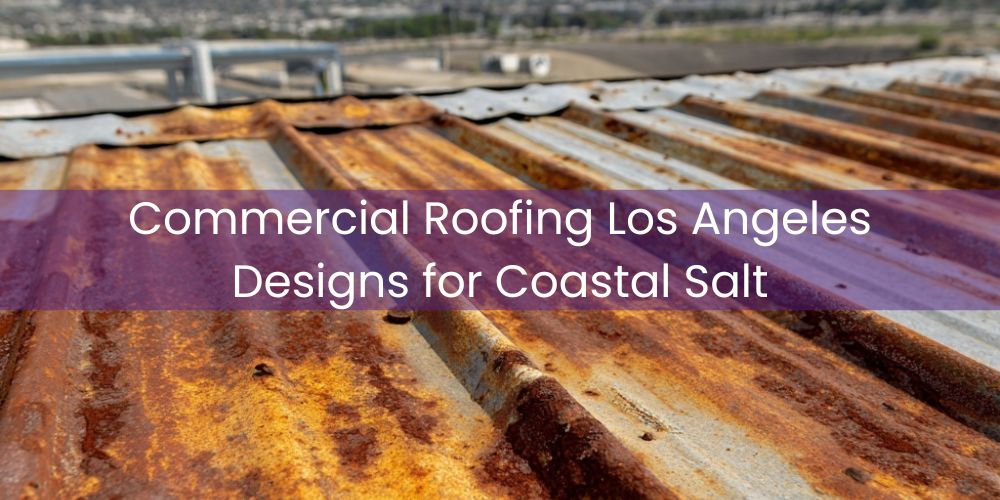
Commercial Roofing Los Angeles designs commercial roofing systems across Los Angeles specifically to protect commercial buildings from roof system degradation caused by coastal salt exposure. In Los Angeles’s coastal-influenced environment, commercial roofs are regularly exposed to airborne salt aerosols and chloride particles carried inland from the Pacific Ocean. These salt deposits settle on roof surfaces, metal components, fasteners, seams, and penetrations, where they attract moisture and accelerate corrosion and material breakdown. Over time, this exposure degrades protective coatings, corrodes metal elements, weakens attachment points, and compromises the components responsible for maintaining waterproofing and structural continuity. If not addressed at the design level, ongoing salt exposure creates latent vulnerabilities that develop into leaks, fastener failure, edge system instability, and premature roof failure. Commercial Roofing Los Angeles engineers roof systems specifically to tolerate prolonged coastal salt exposure without losing structural stability or waterproofing performance. By selecting corrosion-resistant materials, protective coatings, compatible fasteners, and salt-tolerant assembly methods, we design roofs that maintain integrity under continuous marine influence. These systems allow commercial buildings to remain watertight, operational, and financially protected despite long-term exposure to coastal salt conditions common throughout Los Angeles.
How Do Commercial Roof Designs Protect Los Angeles Buildings From Coastal Salt Exposure?
Los Angeles commercial roofs operate under persistent corrosive stress created by airborne salt and chloride deposition rather than isolated weather events. Salt particles settle on membranes, coatings, seams, flashings, fasteners, and metal components, where they retain moisture and accelerate oxidation and galvanic corrosion. On the low-slope concrete, steel, and wood-framed commercial buildings common throughout Los Angeles, this corrosion develops gradually, weakening fasteners, degrading protective finishes, and reducing the effectiveness of bonded and mechanically restrained interfaces. This degradation does not typically cause immediate leaks but creates progressive loss of restraint and material integrity that later becomes active failure pathways during normal rain or wind events. Commercial Roofing Los Angeles designs commercial roofing systems for Los Angeles because controlling salt-driven corrosion at the assembly level is the only way to prevent this failure mechanism. Roof components are selected for corrosion resistance, material compatibility, and long-term exposure tolerance so chloride deposition does not initiate premature breakdown. Seam, flashing, and penetration details are engineered to limit moisture retention and prevent corrosive buildup at critical interfaces. Fasteners and edge systems are specified to resist corrosion-induced loss of clamping force under coastal conditions. By managing how salt exposure interacts with membranes, metals, fasteners, and attachments, corrosive stress is prevented from progressing into mechanical separation, moisture intrusion, and premature roof failure. This system-level approach allows commercial roofs in Los Angeles to withstand ongoing coastal salt exposure while remaining dry, stable, and fully operational throughout their service life.
How Does Coastal Salt Exposure Create Failure Pathways on Los Angeles Commercial Roofs?
Coastal salt exposure creates failure pathways on Los Angeles commercial roofs by accelerating corrosion and material breakdown at the components responsible for structural attachment and waterproofing continuity. Airborne salt aerosols and chloride particles settle on roof membranes, coatings, seams, flashings, fasteners, and metal edge systems, where they attract and retain moisture. On the low-slope concrete, steel, and wood-framed commercial buildings common throughout Los Angeles, this moisture retention intensifies oxidation, galvanic corrosion, and coating degradation rather than remaining a surface-level condition. Over time, salt-driven corrosion reduces fastener clamping force, weakens metal components, and compromises bonded and mechanically restrained interfaces. This degradation does not typically cause immediate leaks but creates latent loss of restraint and micro-separation that later become active failure pathways during routine rain or wind events. Commercial Roofing Los Angeles designs commercial roofing systems for Los Angeles because preventing salt-driven corrosion at the material and interface level is the only way to stop this failure mechanism. Roof assemblies are engineered to resist chloride exposure so corrosive processes do not undermine mechanical restraint or waterproofing continuity. Corrosion-resistant fasteners, compatible metals, and protective coatings are specified to limit oxidation and galvanic interaction under coastal conditions. Seam, flashing, penetration, and edge details are designed to reduce moisture retention and prevent salt accumulation at critical interfaces. By controlling how salt exposure interacts with membranes, metals, fasteners, and attachment points, corrosive stress is prevented from progressing into mechanical separation, water intrusion, and premature roof system failure.
The salt-driven failure pathway mechanisms described above can be reduced to direct cause-and-effect relationships between chloride exposure, corrosion processes, and moisture intrusion below.
- Airborne salt deposition → moisture retention at metal components → accelerated corrosion
- Chloride exposure at fasteners → loss of clamping force → attachment point separation
- Salt-induced coating breakdown → exposed substrates → material degradation
- Corrosion at edge systems → reduced mechanical restraint → progressive separation
- Corrosion-resistant materials and detailing → stabilized interfaces → failure pathways do not form
Have a question about an upcoming project?
Where Does Salt-Driven Corrosion Concentrate on Los Angeles Commercial Roofs?
Commercial roofing systems on buildings in Los Angeles experience salt-driven corrosion as a moisture-accelerated, chemically induced stress that concentrates at roof locations where metal components, fasteners, and interfaces are exposed, bonded, or mechanically restrained. In coastal-influenced areas of Los Angeles, airborne salt aerosols settle unevenly across roof assemblies rather than dispersing uniformly. Corrosive exposure concentrates where salt can accumulate, moisture can dwell, and protective coatings are thin or disrupted. These conditions cause corrosion to develop at interfaces and attachment points rather than across uninterrupted membrane fields. Over time, concentrated corrosion reduces mechanical restraint and compromises waterproofing continuity at specific, predictable locations. Metal attachment points and fasteners are the primary concentration zones for salt-driven corrosion. Chloride particles collect at fastener heads, plates, and exposed threads, where moisture retention accelerates oxidation and galvanic reaction. As corrosion progresses, fasteners lose clamping force and structural capacity, increasing movement at surrounding materials. Once restraint is reduced, these locations become latent separation points that activate as leak pathways during routine rain or wind events. Edge systems, coping assemblies, and perimeter metal components experience another high concentration of salt-driven corrosion due to direct exposure and airflow patterns that deposit salt along building edges. Protective finishes at these locations degrade more rapidly under chloride exposure, allowing corrosion to undermine edge securement and mechanical continuity. As edge restraint weakens, wind and thermal forces further enlarge openings, accelerating progressive separation and increasing the risk of water intrusion beneath the roof assembly. Roof penetrations and equipment curbs also intensify salt-driven corrosion because they combine metal components, sealants, and complex geometries that trap moisture and salt residue. Corrosion at curb flashings, penetration collars, and mounting hardware weakens attachment and sealant bonds, creating direct pathways for air and moisture intrusion once degradation advances. Salt-driven corrosion concentrates at these locations because chemical exposure accumulates where materials change, terminate, or rely on mechanical restraint. Roof assemblies that fail to control corrosion at fasteners, edges, and penetrations allow localized chemical degradation to convert into mechanical separation, moisture entry, and progressive roof system failure.
In Los Angeles, coastal salt exposure creates predictable roof failure paths at fasteners, perimeter metals, and penetrations; these failure paths can be reduced to direct cause-and-effect relationships between chloride deposition, corrosion, and loss of restraint below.
- Salt deposition at fasteners → corrosion and clamping force loss → attachment point separation
- Chloride exposure at edge metal → coating breakdown → perimeter instability
- Moisture and salt at penetrations → hardware corrosion → seal and attachment failure
- Corrosion-resistant detailing → preserved restraint → failure pathways do not form
When Does Coastal Salt Exposure Require Professional Roofing Intervention in Los Angeles?
Coastal salt exposure requires professional roofing intervention on Los Angeles commercial roofs when chloride-driven corrosion has begun to compromise fasteners, edge systems, penetrations, or metal components, but the roof deck and insulation remain structurally serviceable. On low-slope commercial buildings in Los Angeles, early indicators include corrosion at fastener heads or plates, flaking or blistering of protective metal coatings, loosening edge metal, staining around penetrations, or leaks that appear after routine rain or wind events rather than prolonged weather exposure. These conditions signal that salt-induced corrosion is no longer being contained at the surface level and is beginning to reduce mechanical restraint and waterproofing continuity within the roof assembly. Under Los Angeles coastal conditions, where airborne salt and chloride exposure occur continuously and accelerate corrosion through moisture retention, intervention is appropriate when degradation is confined to metal components, attachment points, and interface details rather than widespread insulation saturation or deck deterioration. At this stage, professional evaluation focuses on fastener integrity, edge system securement, metal compatibility, penetration detailing, coating condition, and subsurface moisture presence to determine whether targeted corrective work can arrest salt-driven failure progression. When addressed before corrosion advances into structural attachment loss and uncontrolled separation, professional intervention stabilizes mechanical restraint, preserves waterproofing continuity, and delays the need for full roof replacement despite ongoing coastal salt exposure.