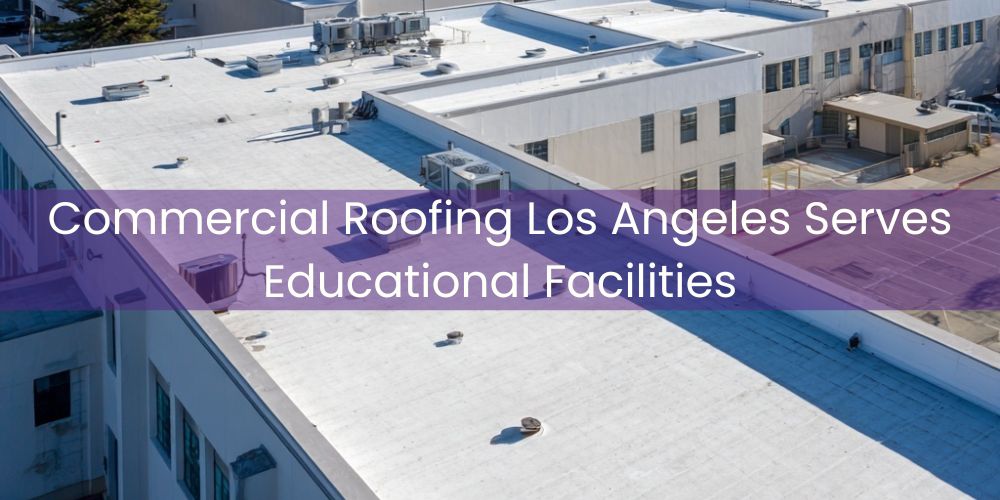
Commercial Roofing Los Angeles serves educational facilities across Los Angeles by designing commercial roofing systems that protect long-life, safety-critical buildings from progressive roof failure and disruption to learning environments. Educational facilities typically include classrooms, administrative buildings, laboratories, gymnasiums, auditoriums, and shared-use spaces that must remain safe, dry, and operational for decades. These buildings experience unique roof stress conditions driven by aging infrastructure, seasonal occupancy cycles, limited maintenance windows, and strict safety and liability requirements. Over time, unmanaged stress at seams, penetrations, attachment points, perimeters, and roof fields can allow moisture intrusion that affects occupied learning spaces and sensitive interior finishes. If not addressed at the design level, localized roof degradation can escalate into leaks, safety concerns, unplanned closures, and costly emergency repairs. Commercial Roofing Los Angeles engineers roof systems specifically to support the long service life, predictable performance, and risk sensitivity required of educational environments without sacrificing durability or waterproofing continuity. By integrating age-tolerant assemblies, reinforced detailing, and attachment strategies designed for long-term stability, we design roofs that remain dependable as buildings age. These systems allow educational facilities to remain safe, functional, and operational throughout Los Angeles.
How Do Commercial Roof Designs Support Educational Facilities in Los Angeles?
Educational facility roofs in Los Angeles operate under stress conditions driven by longevity requirements and safety obligations rather than continuous mechanical operation or high rooftop equipment density. School and campus buildings must maintain watertight roof assemblies over long service lives while accommodating phased renovations, evolving building codes, and seasonal use patterns that limit access for repairs. Rooftop penetrations for mechanical systems, skylights, and safety equipment interrupt waterproofing planes, while large roof areas increase exposure to wind uplift and weather cycling over decades of service. On the low-slope concrete, steel, and wood-framed educational buildings common throughout Los Angeles, these stresses rarely cause immediate failure but gradually weaken seams, flashings, penetrations, perimeters, and attachment systems that must protect occupied spaces below. Commercial Roofing Los Angeles designs roofing systems for educational facilities because controlling age-related degradation and safety risk at the assembly level is the only way to maintain long-term reliability. Roof membranes are selected for durability, dimensional stability, and resistance to long-term environmental exposure. Attachment systems and perimeter details are engineered to resist wind pressure and movement without progressive loosening over extended service periods. Seam, flashing, and penetration detailing is designed to maintain restraint and waterproofing continuity as buildings age and undergo periodic upgrades. By managing how time, weather exposure, wind pressure, and phased use interact with roof components, educational facility roofs remain predictable, safe, and suitable for uninterrupted learning environments.
How Do Aging Infrastructure, Seasonal Occupancy, and Wind Exposure Create Failure Pathways on Educational Facility Roofs in Los Angeles?
Aging infrastructure, seasonal occupancy cycles, and wind exposure create failure pathways on educational facility roofs in Los Angeles by progressively degrading the components responsible for structural attachment and waterproofing continuity over long service lives. Educational buildings are designed to remain in use for decades, during which roof membranes, sealants, fasteners, flashings, and perimeter systems are exposed to repeated thermal cycling, environmental weathering, and wind pressure while maintenance access is often constrained by academic calendars. On the low-slope concrete, steel, and wood-framed educational buildings common throughout Los Angeles, this combination of time-dependent material aging and deferred access reduces membrane flexibility, weakens bonded interfaces, and loosens mechanical restraint rather than causing immediate failure. Over time, age-driven material fatigue and attachment degradation create latent loss of compression and micro-separation at seams, penetrations, perimeters, and attachment points. These latent conditions typically remain undetected until routine wind or rain events activate them into moisture intrusion that affects classrooms, laboratories, gyms, and other occupied learning spaces. Commercial Roofing Los Angeles designs commercial roofing systems for educational facilities because controlling time-driven degradation and wind-activated movement at the material and interface level is the only way to stop this failure mechanism. Roof assemblies are engineered to maintain restraint and waterproofing continuity over extended service periods rather than short operational cycles. Durable membranes, long-life attachment systems, and reinforced edge and penetration detailing are specified to resist aging-related loss of performance. Seam, flashing, penetration, and perimeter details are designed to tolerate deferred maintenance intervals without allowing progressive separation. By controlling how aging, occupancy cycles, and wind exposure interact with roof materials and interfaces, long-term degradation is prevented from progressing into active leaks, safety risks, and disruption to learning environments.
The aging-related failure pathway mechanisms described above can be reduced to direct cause-and-effect relationships between material degradation, access constraints, and moisture intrusion below.
- Long-term material aging → reduced flexibility and bond strength → interface fatigue
- Seasonal maintenance deferral → unresolved minor defects → progressive degradation
- Wind pressure cycling → movement at fatigued interfaces → separation activation
- Degraded seams and perimeters → loss of waterproofing continuity → moisture intrusion
- Age-tolerant materials and detailing → stabilized interfaces → failure pathways do not form
Have a question about an upcoming project?
How Do Roofing Materials and System Configurations Interrupt These Failure Pathways for Educational Facilities in Los Angeles?
Roofing materials and system configurations interrupt failure pathways on educational facility roofs in Los Angeles by preserving waterproofing continuity and mechanical restraint as buildings age and operate under constrained maintenance cycles. Educational roofs must perform reliably over long service lives, accommodating deferred access, phased upgrades, and repeated wind exposure without allowing age-related degradation to concentrate at seams, penetrations, perimeters, or attachment points. On the low-slope concrete, steel, and wood-framed educational buildings common throughout Los Angeles, properly selected materials and system configurations do not eliminate aging but prevent aging from translating into loss of compression, bond failure, or attachment instability. Long-life membranes, compatible attachment systems, and reinforced interface detailing are used to maintain dimensional stability and restraint as materials weather over decades. These configurations limit movement at vulnerable interfaces and maintain redundancy so localized wear does not propagate into system-wide failure. Commercial Roofing Los Angeles designs commercial roofing systems for educational facilities because interrupting age- and wind-driven degradation at the material and configuration level is the only way to preserve predictable performance in safety-critical learning environments. Roof assemblies are configured to distribute stresses evenly across large roof fields rather than concentrating them at isolated details. Attachment strategies are selected to retain clamping force over extended periods without progressive loosening. Seam, flashing, penetration, and perimeter details are reinforced to tolerate deferred maintenance intervals without allowing separation. By aligning material durability and system configuration with long service-life requirements, failure pathways are interrupted before moisture intrusion and operational disruption occur.
The educational-facility mitigation mechanisms described above can be reduced to direct cause-and-effect relationships between material behavior, system configuration, interface stability, and moisture control.
- Long-life membranes → sustained flexibility and stability → seam integrity preserved
- Compatible attachment systems → retained clamping force over time → restraint maintained
- Reinforced seams and penetrations → maintained compression → waterproofing continuity preserved
- Wind-rated perimeter configurations → controlled edge movement → separation prevented
- System-level stress distribution → interface stabilization → failure pathways do not form
How Do Detailing, Attachment Strategies, and Perimeter Design Protect Educational Facility Roofs in Los Angeles?
Detailing, attachment strategies, and perimeter design protect educational facility roofs in Los Angeles by maintaining mechanical restraint, compression, and waterproofing continuity at seams, penetrations, perimeters, and transitions over long service lives. Educational buildings are expected to perform safely for decades while accommodating aging materials, deferred maintenance windows, phased upgrades, and repeated wind exposure. On the low-slope concrete, steel, and wood-framed educational buildings common throughout Los Angeles, failures rarely originate in open roof fields and instead initiate where components meet and terminate. Without precise detailing and restraint, long-term thermal cycling and wind pressure gradually reduce clamping force, deform flashings, and open micro-gaps at edges and penetrations. Over time, these interface weaknesses allow latent movement to convert into separation and moisture intrusion during routine weather events. Commercial Roofing Los Angeles designs commercial roofing systems for educational facilities because controlling restraint and movement at the interface and perimeter level is essential to preserving safety and long-term reliability. Attachment strategies are engineered to secure membranes and insulation while retaining compression and alignment as materials age. Perimeter systems are designed to resist wind uplift and pressure equalization while maintaining continuous edge restraint across large roof spans. Seam, flashing, penetration, and edge details are configured to tolerate extended service intervals without allowing progressive loss of waterproofing continuity. By stabilizing how roof components connect and terminate, detailing and perimeter design prevent time-driven degradation from progressing into leaks, safety risks, and disruption to learning environments.
The educational-facility protection mechanisms described above can be reduced to direct cause-and-effect relationships between restraint, interface stability, and moisture exclusion.
- Engineered attachment patterns → retained clamping force over time → movement controlled
- Reinforced seam and flashing detailing → maintained compression → waterproofing continuity preserved
- Wind-rated perimeter systems → stabilized edges → uplift-induced separation prevented
- Stabilized penetrations and transitions → restrained interfaces → moisture pathways blocked
- Long-term interface restraint → controlled movement → failure pathways do not form
How Do Inspection, Maintenance, and Monitoring Prevent Educational Facility Roof Failures in Los Angeles?
Inspection, maintenance, and monitoring prevent roof failures on educational facility roofs in Los Angeles by identifying age-related degradation and interface movement early, before deferred wear and wind exposure convert latent defects into active moisture intrusion. Educational buildings operate under long service-life expectations, seasonal access constraints, and strict safety requirements that allow minor roof defects to persist across academic years if not systematically identified. On low-slope concrete, steel, and wood-framed educational buildings common throughout Los Angeles, most failures originate at seams, penetrations, perimeters, and attachment points that gradually lose compression and restraint as materials age. Routine inspection targets these interfaces to detect early loss of clamping force, sealant fatigue, flashing deformation, or moisture presence before leaks reach occupied spaces. Maintenance activities restore compression, reseal interfaces, and stabilize attachments so aging-related movement does not progress unchecked. Monitoring establishes condition baselines across roof zones and tracks change over time, allowing predictable intervention within limited maintenance windows. Commercial Roofing Los Angeles designs commercial roofing systems for educational facilities because lifecycle control through inspection and maintenance is essential to preserving safety, reliability, and uninterrupted learning environments. By detecting and correcting degradation before wind or rain activates it, inspection and maintenance interrupt failure pathways that would otherwise lead to leaks, safety concerns, and unplanned closures.
The educational-facility lifecycle control mechanisms described above can be reduced to direct cause-and-effect relationships between early detection, corrective action, and moisture exclusion.
- Targeted interface inspections → early degradation identified → corrective action initiated
- Routine maintenance at seams and penetrations → restored compression → waterproofing continuity preserved
- Perimeter and attachment evaluations → movement detected early → uplift-related loosening prevented
- Condition monitoring over time → degradation trends identified → predictable intervention enabled
- Early interface stabilization → controlled aging effects → failure pathways do not activate
When Do Aging Roof Systems and Deferred Maintenance Require Professional Roofing Intervention for Educational Facilities in Los Angeles?
Aging roof systems and deferred maintenance require professional roofing intervention on educational facility roofs in Los Angeles when long-term material degradation and interface fatigue have begun to compromise waterproofing continuity or mechanical restraint, but the structural deck and primary insulation remain serviceable. On low-slope educational buildings, early indicators include recurring leaks after routine rain events, seam or flashing movement at aged details, perimeter loosening under wind exposure, sealant failure at penetrations added during phased upgrades, or moisture detected beneath roof membranes without widespread saturation. These conditions indicate that time-driven material aging and constrained maintenance cycles are no longer being safely absorbed within the roof assembly and are beginning to convert latent interface wear into active failure pathways. Under Los Angeles operating conditions, where educational facilities must prioritize safety, predictability, and uninterrupted use of classrooms and shared spaces, intervention is appropriate when degradation is confined to surface materials, attachment zones, and interface details rather than advanced deck deterioration. At this stage, professional evaluation focuses on seam and flashing integrity, penetration detailing, attachment stability, perimeter restraint, moisture migration patterns, and the cumulative effects of deferred maintenance to determine whether targeted corrective work can arrest further progression. When addressed before separation and moisture intrusion advance deeper into the roof assembly, professional intervention stabilizes roof performance, reduces safety and liability risk, and prevents unplanned closures or costly emergency repairs.