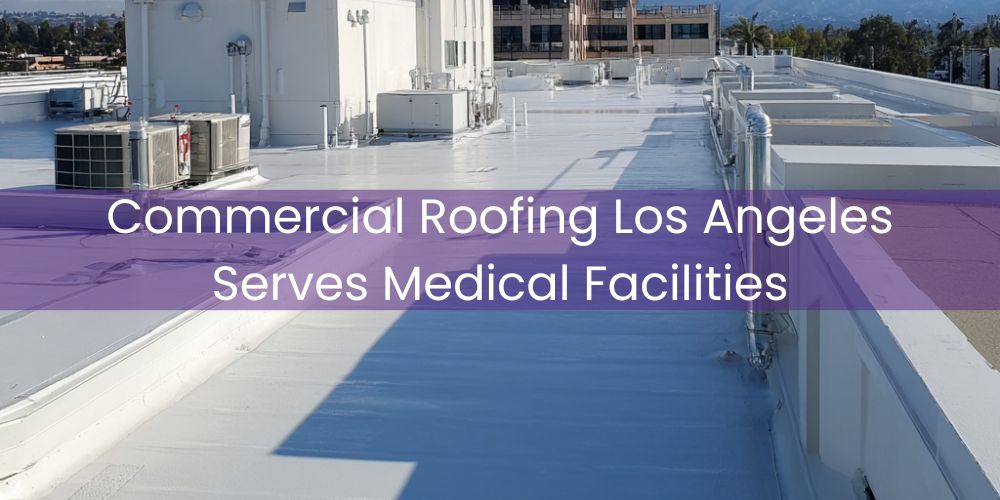
Commercial Roofing Los Angeles serves medical facilities across Los Angeles by designing commercial roofing systems that prioritize reliability, hygiene, and uninterrupted operation in healthcare environments. Hospitals, clinics, surgical centers, and diagnostic facilities depend on roof assemblies that protect sensitive interior spaces, medical equipment, and patient care areas from environmental intrusion. These buildings operate under continuous stress from heat exposure, wind pressure, rooftop mechanical systems, and routine service access, while also requiring strict control of moisture, contamination, and interior climate stability. Over time, unmanaged roof stress can lead to leaks, humidity intrusion, and operational disruption that directly affect patient safety and clinical performance. If not addressed at the design level, even minor roof failures can compromise sterile environments, interrupt procedures, and trigger costly emergency responses. Commercial Roofing Los Angeles engineers roof systems specifically to support the operational demands of medical facilities without sacrificing waterproofing continuity or structural stability. By integrating heat-tolerant assemblies, reinforced attachment systems, contamination-resistant detailing, and redundancy-focused design strategies, we create roofs that perform reliably under constant healthcare use. These systems allow medical facilities to remain dry, compliant, and continuously operational despite the environmental stresses common throughout Los Angeles.
How Do Commercial Roof Designs Support Medical Facilities in Los Angeles?
Medical facility roofs in Los Angeles operate under a reliability-critical performance requirement that exceeds most other commercial building types. Rooftop HVAC systems, air handling units, and exhaust equipment operate continuously to maintain indoor air quality and pressure control, placing sustained mechanical and thermal stress on roof assemblies. Routine rooftop access for maintenance and inspections introduces repeated loading and interface fatigue, while heat exposure accelerates material aging. On the low-slope concrete, steel, and wood-framed medical buildings common throughout Los Angeles, these stresses do not typically cause immediate failure but gradually weaken seams, flashings, penetrations, and attachment points. Commercial Roofing Los Angeles designs roofing systems for medical facilities because controlling environmental stress at the assembly level is the only way to maintain uninterrupted operation. Roof membranes are selected for long-term stability under heat and continuous equipment loading. Attachment systems and edge details are engineered to resist wind uplift and pressure fluctuations that could compromise interior environments. Seam, flashing, and penetration detailing is designed to prevent moisture intrusion and limit contamination risk as materials age. By managing how heat, mechanical loading, and environmental exposure interact with roof components, medical facility roofs remain stable, sanitary, and dependable throughout continuous clinical operation.
How Do Heat, Mechanical Loads, and Environmental Stress Create Failure Pathways on Medical Facility Roofs in Los Angeles?
Heat exposure, continuous mechanical loading, and environmental stress create failure pathways on medical facility roofs in Los Angeles by progressively degrading the materials and interfaces responsible for waterproofing continuity and pressure control. Hospitals and clinics operate rooftop HVAC, air-handling, and exhaust equipment continuously, generating sustained heat and vibration while requiring frequent service access. This results in repeated point loading, interface fatigue, and elevated surface temperatures across membranes, seams, flashings, penetrations, and attachment points. On the low-slope concrete, steel, and wood-framed medical buildings common throughout Los Angeles, these stresses do not usually cause immediate leaks. Instead, they gradually weaken adhesion, compress insulation, and reduce the long-term flexibility of materials that must remain airtight and watertight to protect interior environments. Over time, these stressed interfaces develop latent separation that becomes active failure pathways during routine rain or wind events. Commercial Roofing Los Angeles designs commercial roofing systems for medical facilities because preventing reliability-critical degradation at the assembly level is the only way to stop this failure pattern. Roof membranes are selected for thermal stability and resistance to long-term equipment loading so heat and vibration do not accelerate material breakdown. Reinforced attachment systems and equipment support detailing are engineered to distribute loads without concentrating stress at seams or penetrations. Flashing and penetration details are designed to maintain airtightness and waterproofing continuity as materials age under continuous operation. By controlling how heat, mechanical loads, and environmental exposure interact with roof assemblies, these stressors are prevented from progressing into moisture intrusion, pressure imbalance, and operational disruption.
The medical-facility failure mechanisms described above can be reduced to direct cause-and-effect relationships between sustained operational stress, material degradation, and moisture intrusion below.
- Continuous rooftop equipment operation → sustained heat and vibration → accelerated material aging
- Repeated service access → point loading and interface fatigue → seam and flashing separation
- Elevated surface temperatures → reduced membrane flexibility → loss of waterproofing continuity
- Attachment stress under wind and pressure changes → restraint weakening → leak initiation
- Stabilized assemblies and reinforced detailing → controlled stress transfer → failure pathways do not form
Have a question about an upcoming project?
Where Do Heat, Mechanical Loads, and Environmental Stress Concentrate on Medical Facility Roofs in Los Angeles?
Commercial roofing systems on medical facilities in Los Angeles experience heat, mechanical load, and environmental stress as reliability-critical forces that concentrate at roof locations supporting continuous clinical operation. Unlike general commercial buildings, medical facilities rely on uninterrupted rooftop equipment performance, air pressure control, and environmental stability. As a result, stress does not distribute evenly across roof fields. Instead, degradation concentrates where equipment loads, thermal output, and maintenance access intersect, creating predictable zones of accelerated wear and vulnerability. Rooftop mechanical equipment zones represent the primary concentration points for stress on medical facility roofs. HVAC units, air handlers, exhaust systems, and filtration equipment operate continuously to maintain indoor air quality and pressure balance. These systems generate sustained heat, vibration, and static loads that act directly on membranes, curbs, flashings, and attachment points. Over time, this concentrated stress accelerates membrane aging, weakens flashing bonds, and fatigues attachment systems, creating latent separation zones around equipment bases and penetrations. Service access routes and maintenance areas form a second major concentration zone. Medical facilities require frequent rooftop inspections and servicing to ensure uninterrupted operation. Repeated foot traffic and equipment servicing apply concentrated point loads and abrasion along access paths, seams, and transitions. These stresses compress insulation, abrade protective surfacing, and fatigue seams and flashing details. As deformation accumulates, these areas develop localized low points and weakened interfaces that allow moisture intrusion once separation begins. Roof penetrations, pressure-control interfaces, and perimeter attachment zones further intensify stress concentration on medical facility roofs. Penetrations associated with medical exhaust, intake systems, and emergency equipment interrupt otherwise continuous roof assemblies and rely on long-term seal integrity. Wind pressure fluctuations and thermal movement place additional stress on these interfaces. When combined with heat and mechanical loading, these locations become high-risk failure initiation points if not designed for sustained restraint and stability. Medical facility roof stress concentrates at equipment zones, service routes, penetrations, and attachment interfaces because these locations combine continuous operation, mechanical loading, and environmental exposure. Roof systems that fail to control stress at these locations allow localized degradation to progress into membrane separation, moisture entry, pressure imbalance, and operational disruption.
In Los Angeles, medical facility roof failures follow predictable concentration patterns at mechanical equipment zones, service access routes, penetrations, and attachment interfaces; these patterns can be reduced to direct cause-and-effect relationships between sustained operational stress, localized degradation, and moisture migration below.
- Continuous equipment operation → sustained heat and vibration → accelerated degradation
- Repeated service traffic → insulation compression and surface wear → interface weakening
- Stress at penetrations and curbs → seal fatigue → moisture entry pathways
- Wind and pressure loads at attachment zones → restraint loss → leak initiation
When Do Heat, Mechanical Loads, and Environmental Stress Require Professional Roofing Intervention for Medical Facilities in Los Angeles?
Heat exposure, continuous mechanical loading, and environmental stress require professional roofing intervention on medical facility roofs in Los Angeles when sustained operational demands have begun to compromise membranes, seams, flashings, penetrations, or attachment points, but the roof deck and insulation remain structurally serviceable. On low-slope medical buildings, early indicators include accelerated membrane aging near mechanical equipment, flashing fatigue at penetrations, insulation compression along service routes, loosened fasteners at attachment points, or leaks that appear during routine rain or wind events rather than prolonged storms. These conditions signal that heat, vibration, and repeated loading are no longer being safely absorbed within the roof assembly and are beginning to convert latent material fatigue into active failure pathways. Under Los Angeles operating conditions, where hospitals and clinics depend on uninterrupted HVAC performance, pressure control, and interior environmental stability, intervention is appropriate when degradation is confined to surface materials, interface bonds, and localized attachment zones rather than widespread insulation collapse or deck deterioration. At this stage, professional evaluation focuses on membrane condition, seam and flashing integrity, attachment stability, penetration detailing, insulation deformation, and subsurface moisture presence to determine whether targeted corrective work can arrest reliability-critical failure progression. When addressed before separation and moisture intrusion advance deeper into the roof assembly, professional intervention stabilizes waterproofing continuity, preserves interior pressure and hygiene control, and prevents operational disruption to patient care.