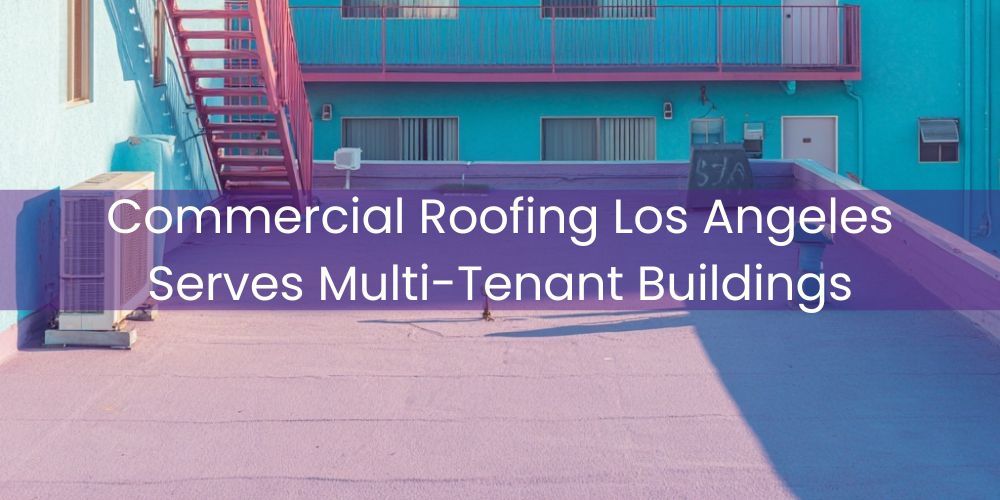
Commercial Roofing Los Angeles serves multi-tenant commercial buildings across Los Angeles by designing roofing systems that protect shared structures, multiple occupants, and continuous business operations from roof-related disruption. Office complexes, mixed-use commercial buildings, and multi-tenant facilities operate under heightened sensitivity to leaks, downtime, and access conflicts because roof failures affect more than one tenant at a time. These buildings experience persistent roof stress from wind pressure, rooftop foot traffic, service access by multiple parties, and environmental exposure across large shared roof areas. Over time, unmanaged stress at seams, penetrations, and attachment points can lead to water intrusion that spreads laterally beneath the membrane, impacting multiple suites and common areas before damage is visible. If not addressed at the design level, even localized roof failures can escalate into tenant complaints, operational disruption, and liability exposure. Commercial Roofing Los Angeles engineers roof systems specifically to support the shared-use demands of multi-tenant buildings without sacrificing waterproofing continuity or structural stability. By integrating reinforced attachment strategies, access-aware detailing, and resilient membrane assemblies, we design roofs that remain dependable under frequent use and varied occupancy. These systems allow multi-tenant buildings to remain dry, reliable, and operational while minimizing disruption to tenants throughout Los Angeles.
How Do Commercial Roof Designs Support Multi-Tenant Commercial Buildings in Los Angeles?
Multi-tenant commercial roofs in Los Angeles operate under a shared-risk performance profile that differs from single-occupant buildings. Rooftop HVAC systems, communications equipment, and service pathways are accessed by multiple contractors and maintenance teams, increasing foot traffic and point loading across roof surfaces. Wind pressure and thermal exposure act across broad roof areas, while penetrations and transitions serving individual tenants interrupt otherwise continuous waterproofing planes. On the low-slope concrete, steel, and wood-framed multi-tenant buildings common throughout Los Angeles, these stresses rarely cause immediate failure but gradually weaken seams, flashings, penetrations, and attachment points that must protect multiple interior spaces. Commercial Roofing Los Angeles designs roofing systems for multi-tenant use because controlling leak risk and access-driven stress at the assembly level is the only way to maintain tenant stability. Roof membranes are selected for durability under frequent access and environmental exposure. Attachment systems and perimeter details are engineered to resist wind pressure without progressive loosening. Seam, flashing, and penetration detailing is designed to prevent lateral moisture migration that can affect multiple tenants at once. By managing how shared access, wind, and environmental stress interact with roof components, multi-tenant roofs remain watertight, predictable, and disruption-free throughout continuous occupancy.
How Do Wind, Foot Traffic, and Shared Access Create Failure Pathways on Multi-Tenant Commercial Roofs in Los Angeles?
Wind exposure, rooftop foot traffic, and shared access create failure pathways on multi-tenant commercial roofs in Los Angeles by mechanically stressing the materials and interfaces responsible for waterproofing continuity across shared roof areas. Multi-tenant buildings support multiple HVAC systems, communications equipment, and service routes accessed by different contractors and maintenance teams. This results in frequent point loading, repeated traversal of seams and transitions, and inconsistent access patterns that concentrate stress at vulnerable interfaces. Wind pressure and thermal cycling act across large roof fields, increasing movement at perimeters, penetrations, and attachment points. On the low-slope concrete, steel, and wood-framed multi-tenant buildings common throughout Los Angeles, these combined stresses rarely cause immediate leaks. Instead, they gradually fatigue seams, loosen fasteners, abrade protective surfacing, and weaken penetration details. Over time, these stressed interfaces develop latent separation that becomes active failure pathways during routine rain or wind events, allowing moisture to migrate laterally beneath the membrane and impact multiple tenant spaces.
Commercial Roofing Los Angeles designs commercial roofing systems for multi-tenant buildings because preventing access-driven mechanical degradation and wind-induced movement at the assembly level is the only way to stop this failure pattern. Roof assemblies are engineered to resist negative pressure and cyclic uplift so loads are transferred safely into the structural deck rather than concentrating at surface components. Reinforced walk paths and access-aware detailing are specified to limit damage from repeated foot traffic. Seam, flashing, and penetration details are designed to maintain restraint and waterproofing continuity despite shared access and varied maintenance activity. By controlling how wind pressure, foot traffic, and shared access interact with roof components, these stressors are prevented from progressing into separation, moisture intrusion, and multi-tenant disruption.
The multi-tenant failure mechanisms described above can be reduced to direct cause-and-effect relationships between environmental loading, access-driven stress, and moisture intrusion below.
- Repeated shared access → seam abrasion and interface fatigue → localized separation
- Wind pressure cycling → attachment loosening → perimeter instability
- Foot traffic across penetrations → seal wear → direct water entry
- Combined stress across shared roof fields → lateral moisture migration → multi-tenant impact
- Reinforced assemblies and access control → stabilized interfaces → failure pathways do not form
Have a question about an upcoming project?
Where Do Wind, Foot Traffic, and Shared Access Concentrate on Multi-Tenant Commercial Roofs in Los Angeles?
Commercial roofing systems on multi-tenant commercial buildings in Los Angeles experience wind exposure, foot traffic, and shared access as cumulative stresses that concentrate at roof locations serving multiple occupants and service functions. Unlike single-tenant buildings, multi-tenant roofs support overlapping equipment zones, shared service routes, and numerous penetrations tied to individual tenant systems. As a result, degradation does not distribute evenly across the roof field but concentrates where environmental forces and access activity intersect. Perimeter edges and corner zones are primary concentration points for wind-driven stress on multi-tenant roofs. Wind accelerates over large roof surfaces and creates elevated uplift pressure at edges and corners, placing continuous stress on fasteners, edge metal, and perimeter attachment systems. As restraint weakens at these locations, separation can initiate and migrate inward, increasing the risk of water intrusion that affects multiple tenant spaces.
Shared service routes and rooftop access corridors form another major concentration zone. Multiple contractors access these paths to service HVAC units, communications equipment, and tenant-specific systems, resulting in repeated foot traffic and point loading. These loads abrade protective surfacing, compress insulation, and fatigue seams and flashing transitions along common access routes. Over time, these areas develop localized deformation and weakened interfaces that allow moisture to migrate laterally beneath the membrane once separation begins. Roof penetrations and transition details further intensify stress concentration on multi-tenant buildings. Each tenant’s mechanical and utility systems introduce penetrations that interrupt otherwise continuous waterproofing planes. Repeated access and environmental exposure accelerate seal wear and attachment fatigue at these interfaces. When combined with wind pressure and shared access activity, these locations become high-risk initiation points for leaks that can impact multiple suites before detection.
In Los Angeles, multi-tenant roof failures follow predictable concentration patterns at perimeter edges, shared service routes, penetrations, and attachment interfaces; these patterns can be reduced to direct cause-and-effect relationships between environmental loading, access frequency, and moisture migration below.
- Wind uplift at perimeters → edge restraint fatigue → separation initiation
- Repeated access along service routes → insulation compression → interface weakening
- High penetration density → seal fatigue → water entry points
- Combined wind and access stress → lateral moisture spread → multi-tenant impact
When Do Wind, Foot Traffic, and Shared Access Require Professional Roofing Intervention for Multi-Tenant Commercial Buildings in Los Angeles?
Wind exposure, rooftop foot traffic, and shared access require professional roofing intervention on multi-tenant commercial buildings in Los Angeles when combined environmental and access-driven stress has begun to compromise seams, penetrations, flashings, or attachment points, but the roof deck and insulation remain structurally serviceable. On low-slope multi-tenant buildings, early indicators include recurring leaks affecting multiple suites, seam movement along shared service routes, insulation compression beneath frequently trafficked areas, loosened edge metal, or water intrusion that appears after routine wind or rain events rather than prolonged storms. These conditions signal that wind pressure and repeated access are no longer being safely absorbed within the roof assembly and are beginning to convert localized interface fatigue into active failure pathways with tenant-wide impact. Under Los Angeles operating conditions, where multiple occupants rely on shared roof systems and uninterrupted operations, intervention is appropriate when degradation is confined to surface materials, interface bonds, and localized attachment zones rather than widespread insulation saturation or deck deterioration. At this stage, professional evaluation focuses on perimeter restraint, seam and flashing integrity, penetration detailing, access-path wear, fastener stability, and subsurface moisture presence to determine whether targeted corrective work can arrest shared-use failure progression. When addressed before separation and lateral moisture migration advance across the roof field, professional intervention stabilizes waterproofing continuity, limits tenant disruption, and reduces liability exposure for building owners and managers.