
Commercial Roofing Los Angeles designs commercial roofing systems across Los Angeles to protect commercial buildings from roof system degradation caused by persistent smog and airborne pollution. In Southern California’s urban environment, commercial roofs are continuously exposed to photochemical smog, particulate matter, and airborne contaminants generated by traffic congestion, industrial activity, and atmospheric inversion. These pollutants settle on roof surfaces and react with heat and sunlight, accelerating material aging and weakening the components responsible for maintaining a continuous waterproof barrier. Over time, this exposure undermines membranes, coatings, seams, flashings, and attachment points, creating latent vulnerabilities that lead to leaks and premature roof failure if not addressed at the design level. Commercial Roofing Los Angeles engineers roof systems specifically to tolerate prolonged exposure to airborne pollutants without losing waterproofing continuity or structural stability. By selecting pollution-resistant materials, protective surface treatments, and compatible assembly methods, we design roofs that maintain integrity under Los Angeles air-quality conditions. These systems allow commercial buildings to remain watertight, operational, and financially protected despite constant exposure to smog and airborne pollution year after year.
How Do Commercial Roof Designs Protect Los Angeles Buildings From Smog and Airborne Pollution?
Los Angeles commercial roofs operate under one of the most persistent atmospheric stress environments in the country, where airborne pollutants are present year-round rather than seasonally. Smog particles and reactive gases settle on roof surfaces daily, embedding into membranes, coatings, and sealants. When combined with solar radiation and heat, these contaminants accelerate chemical breakdown, reduce material elasticity, and weaken adhesion at seams, flashings, and penetrations. On the low-slope concrete, steel, and wood-framed commercial buildings common throughout Los Angeles, this gradual degradation does not cause immediate leaks but creates separation at critical interfaces that later become active leak pathways during normal rain events. Commercial Roofing Los Angeles designs commercial roofing systems for Los Angeles because controlling pollution-driven material degradation at the assembly level is the only way to prevent this failure mechanism. Membranes and coatings are selected for resistance to ozone, particulates, and ultraviolet interaction so surface chemistry remains stable under constant smog exposure. Seam and flashing details are engineered to maintain adhesion and flexibility as materials age, preventing pollutant-induced embrittlement from turning into separation. Drainage interfaces and attachment points are designed to resist contaminant buildup that can interfere with water flow or accelerate corrosion. Commercial Roofing Los Angeles engineers roof assemblies to manage the cumulative effects of airborne pollution, heat, and sunlight that define Los Angeles roof performance. By preserving material integrity, stabilizing critical interfaces, and limiting chemical degradation before it becomes mechanical separation, smog-driven stress is prevented from progressing into active leak pathways. This system-level approach is what allows commercial roofs in Los Angeles to withstand constant exposure to smog and airborne pollution without premature failure, keeping buildings dry, protected, and operational throughout their service life.
How Does Smog and Airborne Pollution Create Leak Pathways on Los Angeles Commercial Roofs?
Smog and airborne pollution in Los Angeles create leak pathways on commercial roofs by accelerating chemical degradation at the surfaces and interfaces responsible for waterproofing continuity. Photochemical smog, particulate matter, and reactive gases settle on roof membranes, coatings, seams, and flashings on a daily basis. When combined with solar radiation and heat, these pollutants break down surface chemistry, reduce material elasticity, and weaken adhesion at bonded interfaces. On the low-slope concrete, steel, and wood-framed commercial buildings common throughout Los Angeles, this degradation develops gradually, creating latent separation points that later become active leak pathways during normal rain events. Commercial Roofing Los Angeles designs commercial roofing systems for Los Angeles because preventing pollution-driven degradation at the material and interface level is the only way to stop this failure mechanism. Roof membranes and coatings are selected for resistance to ozone, airborne particulates, and ultraviolet interaction so surface breakdown does not occur prematurely. Seam and flashing details are engineered to retain flexibility and adhesion as materials age under constant pollutant exposure. Attachment points and drainage interfaces are designed to resist contaminant buildup that can accelerate corrosion or interfere with water flow.
The pollution-driven leak pathway mechanisms described above can be expressed as direct cause-and-effect relationships between airborne contaminants, material degradation, and moisture intrusion below.
- Airborne pollutant deposition → chemical breakdown of membrane surfaces → loss of elasticity and adhesion
- Smog-reactive sealants and coatings → accelerated embrittlement → seam and flashing separation
- Particulate accumulation at interfaces → moisture retention and corrosion → attachment point failure
- Pollution-degraded surfaces → reduced waterproofing continuity → leak activation during routine rain events
- Pollution-resistant materials and details → stabilized interfaces → leak pathways do not form
Have a question about an upcoming project?
Where Does Smog-Driven Degradation Concentrate on Los Angeles Commercial Roofs?
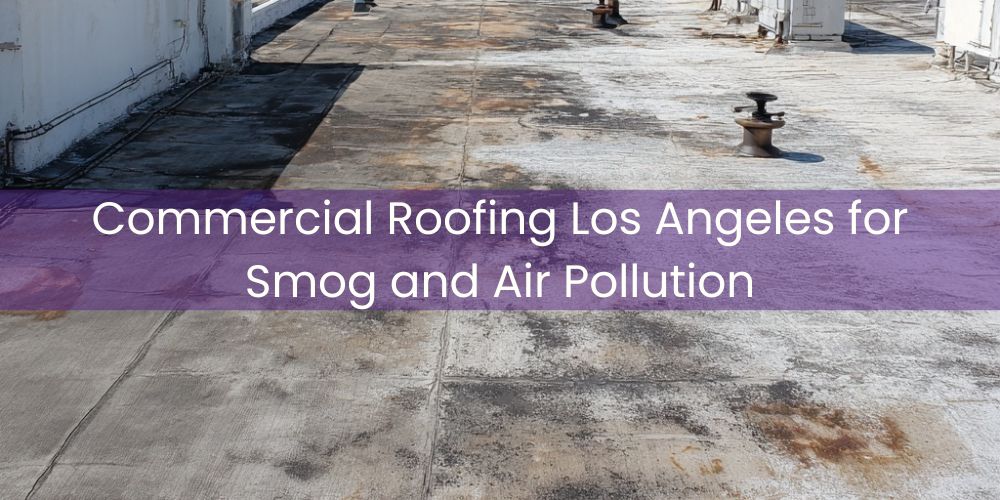
Commercial roofing systems on Los Angeles buildings experience smog-driven degradation as a surface-level, chemically induced stress that concentrates at roof locations where materials are exposed, bonded, or mechanically restrained. In Southern California’s urban environment, photochemical smog, airborne particulates, and reactive gases settle continuously on roof surfaces, embedding into membranes, coatings, seams, flashings, and metal components. When combined with heat and ultraviolet radiation, these pollutants accelerate chemical breakdown and material embrittlement at interfaces rather than across uninterrupted roof fields. Seams and flashing transitions experience the highest smog-related degradation because they rely on long-term adhesion and flexibility to maintain waterproofing continuity. Pollutants accumulate along seam edges and flashing terminations, where sealants and bonding agents are exposed to repeated chemical attack. Over time, this exposure reduces elasticity and adhesion strength, allowing micro-separation to form. Once separation occurs, these interfaces become latent leak entry points that activate during routine rainfall, allowing moisture to migrate laterally beneath the membrane before interior leaks are visible. Metal attachment points and fasteners are another primary concentration zone for smog-driven degradation. Airborne pollutants and particulates collect at fastener heads, plates, and exposed metal edges, promoting corrosion and weakening clamping force. As fasteners lose securement, mechanical restraint increases stress at surrounding materials, enlarging openings that allow water to bypass the membrane surface and enter the roof assembly. This process accelerates insulation saturation and localized deck deterioration once moisture is introduced. Roof penetrations and equipment curbs, particularly around rooftop HVAC units, further intensify smog-driven degradation due to constant exposure and rigid framing. Pollutant deposition at curb flashings and sealant joints accelerates embrittlement and pull-away at these transitions. Because penetrations interrupt otherwise continuous waterproofing planes, degradation at these locations creates direct pathways for moisture intrusion once rainfall occurs. Smog-driven degradation concentrates at these locations because chemical stress accumulates where materials are exposed, bonded, or restrained. Roof assemblies that fail to resist pollutant-induced breakdown at seams, fasteners, and penetrations allow surface degradation to convert into mechanical separation, moisture entry, and progressive system failure.
In Los Angeles, smog and airborne pollution create predictable roof failure paths at seams, fasteners, and penetrations; these failure paths can be reduced to direct cause-and-effect relationships between chemical exposure, material degradation, and moisture migration below.
- Airborne pollutant deposition at seams → chemical embrittlement of sealants → interface separation
- Smog exposure at flashing terminations → adhesion loss → moisture entry during routine rainfall
- Particulate accumulation at fasteners → corrosion and loss of clamping force → water bypass into the assembly
- Pollutant degradation at penetrations and curbs → sealant pull-away → direct insulation exposure
When Does Smog and Airborne Pollution Require Professional Roofing Intervention in Los Angeles?
Smog and airborne pollution require professional roofing intervention on Los Angeles commercial roofs when pollutant-driven material degradation has begun to compromise seams, flashings, penetrations, or attachment points, but the roof deck and insulation remain structurally serviceable. On low-slope commercial buildings, early indicators include surface embrittlement of membranes or coatings, corrosion at fasteners or metal flashings, sealant cracking at penetrations, or staining that appears after routine rain events rather than during prolonged storms. These conditions signal that chemical degradation from prolonged smog exposure is no longer being resisted within the roof assembly and is beginning to convert latent weaknesses into active leak pathways. Under Los Angeles environmental conditions, where photochemical smog and airborne pollutants are present year-round and interact continuously with heat and sunlight, intervention is appropriate when degradation is confined to surface materials and interface bonds rather than full insulation saturation or deck deterioration. At this stage, professional evaluation focuses on seam adhesion, flashing integrity, fastener corrosion, penetration detailing, and subsurface moisture conditions to determine whether targeted corrective work can arrest pollution-driven failure progression. When addressed before mechanical separation and moisture migration advance into the roof assembly, professional intervention stabilizes waterproofing continuity, prevents insulation exposure, and delays the need for full roof replacement despite ongoing exposure to smog and airborne pollution.