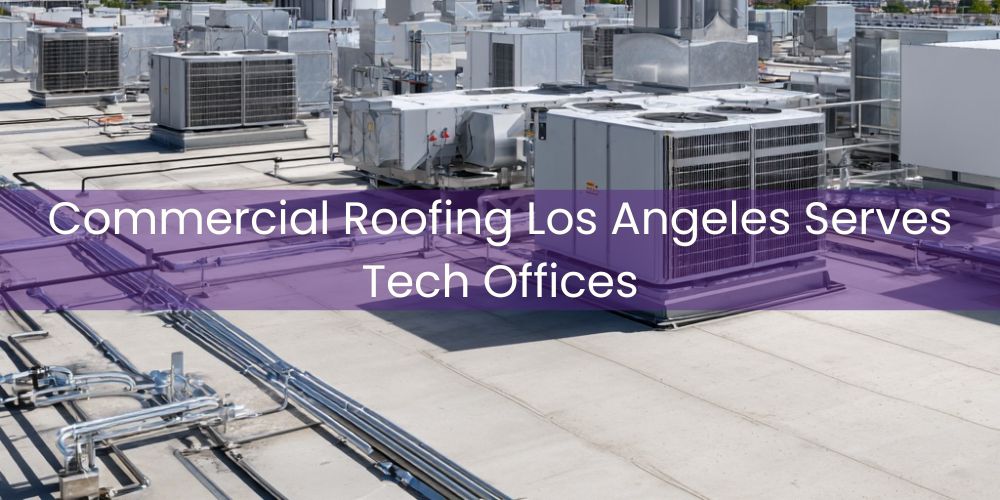
Commercial Roofing Los Angeles serves tech offices across Los Angeles by designing commercial roofing systems that protect equipment-dense, continuously operated buildings from progressive roof failure and operational disruption. Tech offices typically support high concentrations of rooftop HVAC units, dedicated cooling systems, exhaust infrastructure, data-related utilities, and frequent retrofit activity that place sustained mechanical and environmental stress on roof assemblies. These buildings often operate continuously and require tight interior environmental control, placing constant demand on roof systems to remain watertight, structurally stable, and resilient to access-driven wear. Over time, unmanaged stress at seams, penetrations, curbs, attachment points, and roof fields can fatigue membranes, loosen attachments, and compromise waterproofing continuity. If not addressed at the design level, localized roof degradation can escalate into leaks, interior environmental instability, and disruption to sensitive equipment and office operations. Commercial Roofing Los Angeles engineers roof systems specifically to support the equipment density, service access frequency, and uptime expectations of tech office environments without sacrificing durability or performance. By integrating access-tolerant assemblies, reinforced penetration detailing, and wind-resistant attachment strategies, we design roofs that maintain integrity under continuous mechanical operation. These systems allow tech offices to remain dry, stable, and operational throughout Los Angeles.
How Do Commercial Roof Designs Support Tech Offices in Los Angeles?
Tech office roofs in Los Angeles operate under stress conditions driven by equipment density, continuous operation, and strict environmental requirements rather than intermittent occupancy. Rooftop HVAC systems, cooling equipment, exhaust components, and utility penetrations impose sustained loads, vibration, and localized heat on roof assemblies, while frequent service access increases point loading and abrasion across roof surfaces. Large low-slope roof areas further amplify exposure to wind uplift and pressure cycling that act repeatedly on membranes, seams, flashings, curbs, and attachment systems. On the low-slope concrete, steel, and wood-framed tech office buildings common throughout Los Angeles, these stresses do not usually cause immediate failure but gradually weaken interfaces that must remain watertight while supporting uninterrupted building operation. Commercial Roofing Los Angeles designs roofing systems for tech offices because controlling equipment-driven and access-related stress at the assembly level is the only way to maintain long-term reliability. Roof membranes are selected for durability under repeated access, puncture resistance, and tolerance to mechanical movement. Attachment systems and perimeter details are engineered to resist wind pressure and vibration without progressive loosening. Seam, flashing, curb, and penetration detailing is designed to maintain restraint and waterproofing continuity as equipment operates continuously and service access recurs. By managing how equipment loads, vibration, wind pressure, and access interact with roof components, tech office roofs remain dependable, predictable, and fit for uninterrupted operation.
How Do Equipment Density, Vibration, and Wind Exposure Create Failure Pathways on Tech Office Roofs in Los Angeles?
Equipment density, vibration, and wind exposure create failure pathways on tech office roofs in Los Angeles by progressively stressing seams, curbs, equipment supports, penetrations, perimeters, and attachment points that must maintain waterproofing continuity under continuous mechanical operation. Tech offices commonly support dense rooftop HVAC arrays, dedicated cooling equipment, exhaust systems, equipment pads, support frames, and utility infrastructure that introduce sustained static loads, vibration, and localized heat at concentrated zones. At the same time, expansive low-slope roof areas are exposed to wind uplift and pressure cycling that repeatedly act on membranes, fasteners, seams, and edge conditions. On the concrete, steel, and wood-framed tech office buildings typical throughout Los Angeles, these forces rarely cause immediate failure. Instead, they gradually fatigue seams, loosen attachment points, deform curb and equipment-support flashings, and reduce membrane resilience at interfaces subjected to constant movement. Over time, these stressed locations develop latent separation that becomes active failure pathways during routine wind or rain events. Commercial Roofing Los Angeles designs commercial roofing systems for tech offices because preventing equipment- and vibration-driven degradation at the assembly level is the only way to stop this failure pattern. Roof assemblies are engineered to distribute equipment loads and vibration into the structural deck rather than concentrating stress at surface components. Attachment systems and perimeter details are specified to resist cyclic uplift without progressive loosening. Seam, flashing, curb, equipment-support, and penetration detailing is designed to maintain restraint and waterproofing continuity as equipment operates continuously and wind pressure cycles across large roof fields. By controlling how equipment density, vibration, and wind exposure interact with roof components, these stressors are prevented from progressing into separation, moisture intrusion, and operational disruption.
The tech-office failure mechanisms described above can be reduced to direct cause-and-effect relationships between mechanical loading, interface fatigue, attachment instability, and moisture intrusion below.
- High equipment density → concentrated static loads at supports → interface compression and fatigue
- Continuous vibration from mechanical systems → fastener and curb movement → seam and flashing degradation
- Wind pressure cycling across large roof fields → fastener fatigue → attachment loosening
- Retrofit-driven penetrations and equipment upgrades → disrupted waterproofing planes → seal failure pathways
- Load-managed assemblies and reinforced detailing → stabilized interfaces → failure pathways do not form
Have a question about an upcoming project?
How Do Roofing Materials and System Configurations Interrupt These Failure Pathways for Tech Offices in Los Angeles?
Roofing materials and system configurations interrupt failure pathways on tech office roofs in Los Angeles by stabilizing seams, equipment supports, curbs, penetrations, perimeters, and attachment points against vibration, wind-induced movement, and access-driven wear. Tech office roof systems must perform under continuous mechanical operation, dense equipment loading, and frequent retrofit activity that would otherwise accelerate interface fatigue and attachment instability. To counter these forces, roof systems are configured to distribute loads, absorb movement, and preserve waterproofing continuity across large low-slope roof fields. On the concrete, steel, and wood-framed tech office buildings common throughout Los Angeles, properly selected materials and system configurations do not eliminate stress but prevent it from concentrating at vulnerable interfaces. By maintaining controlled restraint and flexibility where movement occurs, these systems interrupt latent separation before it develops into active failure. Commercial Roofing Los Angeles designs commercial roofing systems for tech offices because interrupting equipment- and vibration-driven degradation at the material and configuration level is the only reliable way to preserve continuous operation. Membranes are selected for puncture resistance, tensile strength, and tolerance to repeated access and mechanical movement. Attachment systems are engineered to resist cyclic uplift while allowing controlled flex without progressive loosening. Seam, flashing, curb, equipment-support, and penetration detailing is reinforced to maintain compression and continuity as equipment operates continuously and wind pressure cycles across expansive roof areas. By aligning material performance and system configuration with tech-office stress patterns, failure pathways are neutralized before moisture intrusion and operational disruption can occur.
The tech-office mitigation mechanisms described above can be reduced to direct cause-and-effect relationships between material behavior, system configuration, interface stability, and moisture control.
- Durable, vibration-tolerant membranes → reduced surface fatigue → seam integrity preserved
- Load-distributing system configurations → stabilized equipment supports → interface compression controlled
- Pressure-rated attachment systems → controlled membrane movement → fastener fatigue prevented
- Reinforced seams, curbs, and penetrations → maintained compression → waterproofing continuity preserved
- System-level stress distribution → interface stabilization → failure pathways do not form
How Do Detailing, Attachment Strategies, and Perimeter Design Protect Tech Office Roofs in Los Angeles?
Detailing, attachment strategies, and perimeter design protect tech office roofs in Los Angeles by controlling movement, maintaining compression, and preserving waterproofing continuity at seams, equipment supports, curbs, penetrations, edges, and transitions subjected to continuous mechanical operation. Tech offices concentrate rooftop equipment, vibration sources, and retrofit activity at specific interfaces where even minor detailing weaknesses can allow stress to accumulate. While materials and system configurations establish baseline capacity, long-term performance depends on how loads and movement are restrained where roof components meet. On the concrete, steel, and wood-framed tech office buildings common throughout Los Angeles, failures most often initiate at inadequately reinforced equipment supports, under-restrained curbs, poorly terminated perimeters, and attachment zones that permit incremental movement under vibration and wind pressure. Effective detailing and attachment do not eliminate stress; they manage how stress is transferred so interfaces remain compressed, aligned, and watertight. Commercial Roofing Los Angeles designs commercial roofing systems for tech offices because interface-level control is essential to preventing progressive failure in equipment-dense environments. Attachment strategies are engineered to secure membranes, insulation, and cover boards while allowing controlled movement without fastener fatigue or seam tearing. Perimeter systems are designed to resist wind uplift and pressure equalization while maintaining continuous edge restraint across long roof runs. Seam, flashing, curb, equipment-support, and penetration details are configured to preserve compression and waterproofing continuity as vibration persists and service access recurs. By stabilizing how roof components connect, terminate, and transition, detailing and perimeter design prevent localized interface stress from evolving into system-wide failure.
The tech-office protection mechanisms described above can be reduced to direct cause-and-effect relationships between restraint, movement control, interface stability, and moisture exclusion.
- Engineered attachment patterns → controlled restraint under vibration → cyclic movement absorbed
- Reinforced equipment-support and curb detailing → maintained compression → interface deformation prevented
- Wind-rated perimeter systems → edge stabilization → uplift-induced separation prevented
- Stabilized seams and penetrations → restrained interfaces → waterproofing continuity maintained
- Controlled restraint across critical interfaces → stress dissipation → failure pathways do not form
How Do Inspection, Maintenance, and Monitoring Prevent Tech Office Roof Failures in Los Angeles?
Inspection, maintenance, and monitoring prevent tech office roof failures in Los Angeles by identifying early-stage interface degradation and correcting it before vibration, equipment loading, and wind exposure convert latent stress into active failure pathways. Tech office roofs operate under continuous mechanical demand, dense rooftop equipment, and frequent retrofit activity that progressively affect seams, equipment supports, curbs, penetrations, perimeters, and attachment points even when systems are properly designed. While materials, configurations, and detailing control how stress is absorbed, long-term performance depends on whether emerging degradation is detected and stabilized in service. On the concrete, steel, and wood-framed tech office buildings common throughout Los Angeles, most roof failures originate from small, incremental changes at interfaces that are not visible from interior spaces until moisture intrusion or environmental instability occurs. Structured inspection and monitoring focus on the exact locations where vibration, loading, and access-driven wear accumulate first, allowing corrective action while waterproofing continuity and attachment integrity are still intact. Commercial Roofing Los Angeles designs commercial roofing systems for tech offices because lifecycle control through inspection and maintenance is essential to sustaining uninterrupted operation in equipment-dependent environments. Inspection protocols evaluate equipment supports, seams, curbs, penetrations, perimeters, and attachment zones for early signs of movement, compression loss, abrasion, or fastener fatigue. Maintenance activities restore compression, reseal interfaces, and re-stabilize attachments before movement progresses into separation. Ongoing monitoring establishes performance baselines so changes in condition are identified and addressed predictably rather than reactively. By detecting and correcting degradation at the interface level, inspection and maintenance prevent routine tech office stresses from activating failure pathways that lead to leaks, equipment risk, and operational disruption.
The tech-office lifecycle control mechanisms described above can be reduced to direct cause-and-effect relationships between early detection, corrective action, interface stabilization, and moisture exclusion.
- Targeted interface inspections → early degradation identified → corrective action initiated
- Routine maintenance at seams, supports, and penetrations → restored compression → waterproofing continuity preserved
- Monitoring of vibration-prone equipment zones → movement trends detected → attachment fatigue controlled
- Perimeter and attachment evaluations → uplift response assessed → loosening prevented
- Early intervention at stressed interfaces → stabilized assemblies → failure pathways do not activate
When Do Equipment Density, Vibration, and Wind Exposure Require Professional Roofing Intervention for Tech Offices in Los Angeles?
Equipment density, vibration, and wind exposure require professional roofing intervention on tech office roofs in Los Angeles when sustained mechanical stress and environmental loading have begun to compromise membranes, seams, equipment supports, curbs, penetrations, perimeters, or attachment points, while the structural deck and primary insulation remain serviceable. On low-slope tech office buildings, early indicators include seam movement near equipment zones, flashing deformation at curbs or support frames, fastener loosening in roof fields or perimeters, accelerated membrane wear along service paths, or leaks that appear during routine wind or rain events rather than extreme weather. These conditions indicate that continuous equipment operation, vibration, and wind pressure are no longer being safely absorbed within the roof assembly and are beginning to convert latent interface fatigue into active failure pathways. Under Los Angeles operating conditions, where tech offices depend on uninterrupted uptime, environmental stability, and protection of sensitive interior systems, intervention is appropriate when degradation is confined to surface materials, interface bonds, sealant systems, and localized attachment zones rather than widespread insulation saturation or deck deterioration. At this stage, professional evaluation focuses on equipment support detailing, seam and flashing integrity, penetration restraint, attachment stability, perimeter performance, retrofit-related penetrations, and subsurface moisture presence to determine whether targeted corrective work can arrest failure progression. When addressed before separation, compression loss, and moisture migration advance deeper into the roof assembly, professional intervention stabilizes waterproofing continuity, protects equipment-dependent operations, and prevents escalation into downtime or premature roof replacement.