Commercial Roofing Los Angeles provides commercial roofing services across Los Angeles specifically to protect business-owned buildings from heat-driven roof failure, UV degradation, and operational disruption. In Los Angeles, prolonged high temperatures and intense ultraviolet exposure accelerate membrane oxidation, dry out sealants, weaken flashing bonds, and increase thermal movement across commercial roof assemblies. When these failure mechanisms are left unmanaged, they lead directly to leaks, interior damage, energy loss, and downtime that interrupts normal business operations. We design, install, and maintain commercial roofing systems to control these risks at the system level, allowing business owners to keep their properties operational, compliant, and financially protected in Los Angeles’s climate. Our commercial roofing services are engineered around the risks that heat and UV exposure create for business assets. We use radiation-reflective roof coatings to reduce surface temperatures, slow material aging, and limit daily expansion and contraction that causes cracking and blistering. Heat-stable membranes and reinforced roofing systems are selected to tolerate prolonged sun exposure without losing flexibility or waterproofing performance. By integrating these materials across the roof deck, insulation, fasteners, and membrane layers, we reduce the probability of leaks, structural deterioration, and emergency repairs that disrupt tenant occupancy, inventory storage, and day-to-day business activity. We focus our work on the roof components that pose the greatest financial and operational risk to business owners. Membranes, flashings, penetrations, edge details, and panel systems are the most common sources of heat-related failure on commercial buildings because they experience the highest UV exposure and the greatest thermal movement. Our detailing and maintenance practices are designed to keep these components watertight, flexible, and structurally sound so moisture cannot enter the building envelope and compromise interior spaces, equipment, or revenue-generating operations.
How Does Los Angeles Building Stock Shape Roofing Decisions for Business Owners?
Los Angeles’s commercial building stock directly determines how roofs must be designed to protect business owners. Many commercial properties in the region are low-slope concrete, steel, or wood-framed structures with large roof areas, rooftop HVAC equipment, and constant service foot traffic. These buildings absorb and retain heat throughout the day, placing continuous stress on seams, membranes, and penetrations. Without roofing systems designed for these conditions, business owners face recurring leaks, rising energy costs, and premature roof replacement. To manage these risks, we install roofing materials with high tensile strength and sufficient elongation to absorb thermal expansion without splitting or separating. Reinforced membranes and multi-layer assemblies protect high-traffic areas around mechanical equipment, reducing punctures and abrasion that lead to unexpected water intrusion. These material choices are made to protect the long-term value of the building and reduce unplanned repair costs for business owners. Insulation design is equally critical for protecting business operations. Properly specified insulation limits heat transfer into the building, stabilizes roof temperatures, and reduces the expansion-contraction cycles that accelerate membrane failure. This not only extends roof service life but also improves indoor comfort and energy efficiency, directly lowering operating expenses for business owners. Drainage and component detailing complete the system. Los Angeles commercial roofs must shed water efficiently during heavy rain events to prevent ponding that compounds heat-related deterioration. We design and maintain drainage paths, fasteners, flashings, and edge conditions to prevent water accumulation and structural damage. This system-level approach ensures commercial roofs remain reliable assets that support uninterrupted business operations, protect interior investments, and preserve property value over time.
https://commercialroofinglosangeles.co/blog/high-solar-exposure/How Does Commercial Roofing Los Angeles Protect Business Assets?
Commercial Roofing Los Angeles protects business assets by designing, installing, and maintaining commercial roofing systems that prevent heat-driven roof failure, UV degradation, and water intrusion on business-owned buildings. In Los Angeles, sustained high temperatures, intense ultraviolet exposure, coastal winds, and seasonal rainfall place continuous stress on commercial roof assemblies. If these forces are not controlled at the system level, they cause membrane oxidation, seam separation, fastener corrosion, and drainage failure, which lead directly to leaks, interior damage, energy loss, and operational downtime that disrupt revenue-generating activity.
Commercial roofing services are applied to eliminate these failure mechanisms before they impact business operations. Each service is selected based on the specific environmental stress it mitigates and the asset risk it prevents:
- Deck waterproofing → prolonged UV exposure and moisture intrusion → prevents deck corrosion and structural degradation
- Seam sealing and reinforcement → daily heat expansion and contraction → blocks lateral water migration beneath the membrane
- Drain installation and maintenance → heavy rainfall events → prevents ponding and insulation saturation that damage interior spaces
- Membrane system selection → wind uplift and pressure differentials → prevents water and air intrusion into the building envelope
- Corrosion-resistant fasteners and attachments → coastal salt exposure → prevents fastener failure and loss of roof securement
By applying these controls as a coordinated roofing system rather than isolated repairs, Commercial Roofing Los Angeles enables business owners to protect inventory, equipment, tenant spaces, and interior finishes from moisture damage. This system-level approach extends roof service life, stabilizes operating costs, and preserves the long-term value of commercial properties under Los Angeles climate conditions.
Have a question about an upcoming project?
Where Does Commercial Roofing Los Angeles Interrupt Heat-Driven Failure Paths on Business Roofs?
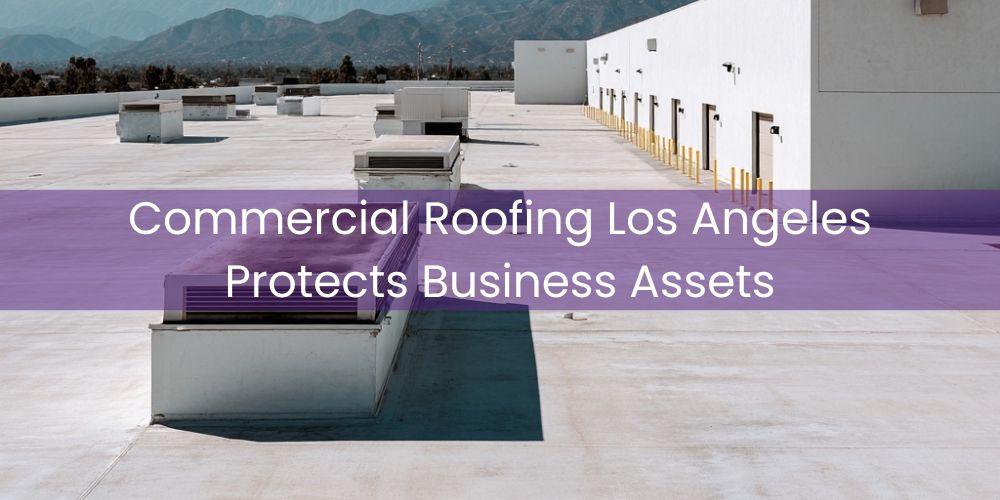
Commercial Roofing Los Angeles protects business assets by interrupting the specific roof zones where heat-driven deterioration and water intrusion originate on Los Angeles commercial buildings. In this climate, sustained solar exposure does not degrade roof systems evenly. Failure begins at roof interfaces where materials move, penetrate, or transition, including field membranes under thermal load, skylight curbs, and rooftop equipment zones. These locations experience concentrated heat buildup, repeated expansion and contraction, and accelerated sealant breakdown, which allows moisture to enter the roof assembly and migrate into occupied spaces below. On large flat roof fields, prolonged surface heating causes membranes to expand during the day and contract rapidly after sunset. Over time, this movement fatigues the membrane surface and weakens attachment points, creating micro-fractures that admit water. By applying radiation-reflective coatings and heat-stable membrane systems, we reduce surface temperatures and slow thermal cycling so membrane movement remains within tolerances and does not reopen leak paths that threaten interior operations and stored assets. Skylight assemblies and their surrounding flashings represent another primary failure origin where heat concentrates at material transitions. Continuous solar exposure accelerates sealant drying and flashing shrinkage around skylight curbs, allowing water to bypass the membrane during rain events. We interrupt this pathway by reinforcing flashing interfaces, restoring flexible seals, and isolating heat-absorbing surfaces so thermal stress does not fracture the waterproofing envelope or compromise interior workspaces beneath skylight openings. Rooftop HVAC zones create compounded stress where heat exposure overlaps with mechanical vibration and service traffic. Penetrations beneath equipment bases experience constant movement, which fractures aged sealants and loosens attachment points. Left untreated, these openings allow water to migrate laterally beneath the membrane and into insulation layers. We stabilize these zones by reinforcing penetration details, installing heat-reflective protection around equipment pads, and restoring watertight transitions so thermal movement and vibration are absorbed without reopening moisture paths that would damage equipment, ceilings, or electrical systems.
Commercial Roofing Los Angeles protects business assets can be reduced to direct cause-and-effect relationships between localized heat stress, roof system failure paths, and targeted interventions that interrupt those paths before damage reaches interior spaces.
- Flat roof field stabilization → solar heat and thermal cycling → membrane fatigue does not open leak paths
- Skylight flashing reinforcement → localized heat concentration → seal failure does not admit water
- HVAC penetration stabilization → heat, vibration, and foot traffic → moisture does not migrate beneath membranes
When Do Los Angeles Commercial Roofs Require Professional Evaluation?
Commercial Roofing Los Angeles evaluates Los Angeles commercial roofs when localized failures begin developing at membranes, seams, penetrations, flashings, or drainage points, even though the broader roof system may still be serviceable. Under sustained sun exposure, daily thermal expansion, and coastal moisture, roofing materials dry, shrink, and lose elasticity, allowing seams to separate and fasteners to loosen. Once these conditions occur, water can migrate beneath the roof assembly and into insulation layers before widespread leaks are visible inside the building. We assess where heat-driven degradation has compromised waterproofing continuity and how moisture is moving through the roof system, not just whether active leaks are present. Indicators that evaluation is required include recurring leaks after hot or wet weather, interior staining beneath penetrations, ponding water that does not dissipate, seam movement, or corrosion bleed-through at attachment points. Based on these findings, we determine whether targeted interventions—such as seam reinforcement, penetration stabilization, drainage correction, or localized coating restoration—can stabilize the roof system and prevent damage from spreading into the deck, interior spaces, or operational areas.