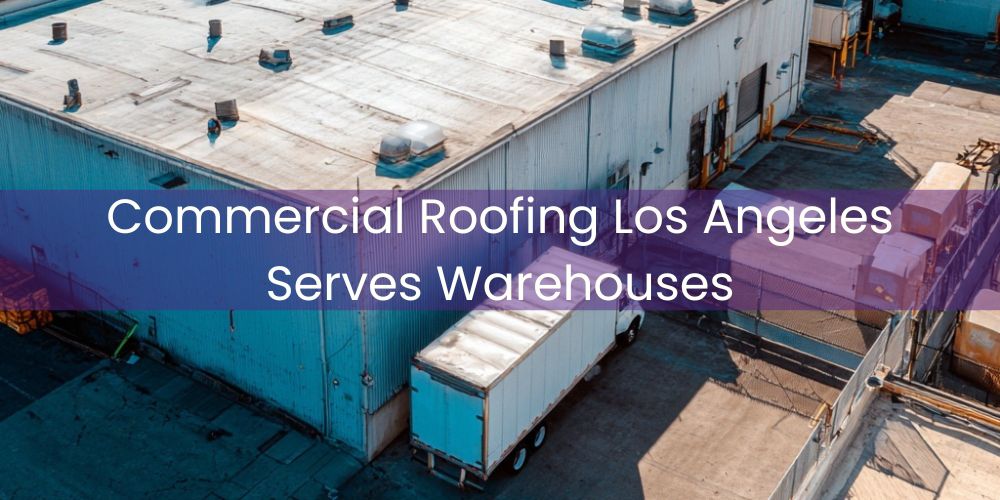
Commercial Roofing Los Angeles serves warehouses and distribution centers across Los Angeles by designing commercial roofing systems engineered for large roof spans, high wind exposure, and sustained thermal stress. Warehouse and distribution facilities typically feature expansive low-slope roofs, minimal internal partitions, and lightweight structural decks that amplify the effects of wind uplift, solar heat gain, and pressure differentials. These buildings often operate continuously, housing inventory, logistics systems, and automation that depend on uninterrupted roof performance. Over time, unmanaged wind forces, heat exposure, and span-related stress can loosen fasteners, fatigue seams, and compromise waterproofing continuity across wide roof areas. If not addressed at the design level, these conditions create latent vulnerabilities that lead to progressive membrane detachment, water intrusion, and operational disruption. Commercial Roofing Los Angeles engineers roof systems specifically to support the structural and operational demands of warehouses without sacrificing waterproofing or mechanical stability. By integrating pressure-rated attachment strategies, heat-tolerant assemblies, and span-appropriate detailing, we design roofs that maintain integrity across large footprints. These systems allow warehouses and distribution centers to remain dry, reliable, and operational despite the environmental stresses common throughout Los Angeles.
How Do Commercial Roof Designs Support Warehouses and Distribution Centers in Los Angeles?
Warehouse and distribution center roofs in Los Angeles operate under stress conditions driven by scale rather than complexity. Large uninterrupted roof spans increase exposure to wind uplift and pressure cycling, while prolonged sun exposure elevates surface temperatures and accelerates material aging. Minimal internal compartmentalization allows internal air pressure to act uniformly against the roof deck during wind events, increasing uplift demand at fasteners, seams, and perimeter details. On the low-slope concrete, steel, and wood-framed warehouse buildings common throughout Los Angeles, these stresses do not usually cause immediate failure but gradually reduce attachment strength and material resilience across broad roof areas. Commercial Roofing Los Angeles designs roofing systems for warehouses because controlling wind and thermal stress at the assembly level is the only way to maintain long-term performance over large spans. Roof membranes are selected for thermal stability and tensile strength under sustained exposure. Attachment patterns and fastening densities are engineered to resist uplift across expansive roof fields. Seam, edge, and perimeter details are designed to maintain restraint and waterproofing continuity as wind and heat loads cycle over time. By managing how large-span geometry interacts with wind and thermal forces, warehouse roofs remain stable, watertight, and dependable throughout continuous distribution operations.
How Do Wind Uplift, Heat, and Large-Span Stress Create Failure Pathways on Warehouse Roofs in Los Angeles?
Wind uplift, prolonged heat exposure, and large-span structural stress create failure pathways on warehouse roofs in Los Angeles by progressively weakening the attachment systems and interfaces responsible for maintaining waterproofing continuity across expansive roof areas. Warehouses and distribution centers feature wide, uninterrupted low-slope roofs that are highly exposed to wind pressure and solar loading. Sustained winds and gust-driven pressure differentials generate negative pressure across roof fields and concentrated uplift at perimeters, while prolonged sun exposure elevates surface temperatures and accelerates material aging. At the same time, large-span geometry increases the distance between structural supports, placing greater demand on fasteners, seams, and membranes to resist movement and deformation. On low-slope concrete, steel, and wood-framed warehouse buildings common throughout Los Angeles, these stresses rarely cause immediate failure. Instead, they gradually loosen fasteners, fatigue seams, and reduce membrane flexibility across broad areas. Over time, these stressed interfaces develop latent separation that becomes active failure pathways during routine wind or rain events. Commercial Roofing Los Angeles designs commercial roofing systems for warehouses because preventing span-driven mechanical degradation at the assembly level is the only way to stop this failure pattern. Roof assemblies are engineered to resist negative pressure and thermal cycling so loads are transferred safely into the structural deck rather than concentrating at surface components. Pressure-rated attachment patterns and fastening densities are specified to prevent progressive loosening under repeated uplift. Roof membranes are selected for tensile strength and thermal stability so heat exposure does not accelerate cracking or seam failure. Edge, seam, and perimeter details are designed to maintain restraint and waterproofing continuity as wind and thermal forces cycle across large roof spans. By controlling how wind uplift, heat, and span geometry interact with roof components, these stressors are prevented from progressing into membrane detachment, water intrusion, and operational disruption.
The warehouse-driven failure mechanisms described above can be reduced to direct cause-and-effect relationships between wind pressure, thermal stress, span-related movement, and moisture intrusion below.
- Wind uplift across large spans → fastener fatigue → attachment loosening
- Prolonged heat exposure → membrane aging and reduced flexibility → seam vulnerability
- Span-related movement → interface stress → progressive separation
- Perimeter uplift under pressure cycling → edge instability → water entry initiation
- Pressure-rated attachment and detailing → stabilized assemblies → failure pathways do not form
Have a question about an upcoming project?
Where Do Wind Uplift, Heat, and Large-Span Stress Concentrate on Warehouse Roofs in Los Angeles?
Commercial roofing systems on warehouse and distribution center buildings in Los Angeles experience wind uplift, heat, and large-span stress as geometry-driven forces that concentrate at specific roof zones rather than distributing evenly across the roof field. The expansive, low-slope design of warehouse roofs increases exposure to wind pressure and solar loading, while long distances between structural supports amplify movement and attachment demand. As a result, degradation concentrates where uplift forces intensify, where thermal stress accumulates, and where structural restraint changes. Perimeter edges and corner zones are the primary concentration points for wind uplift on warehouse roofs. Wind accelerates over large roof surfaces and concentrates negative pressure at edges and corners, placing continuous stress on fasteners, edge metal, and perimeter attachment systems.
Over time, repeated pressure cycling fatigues fasteners and weakens restraint at these locations. Once perimeter stability is compromised, separation can initiate and migrate inward across the roof field during subsequent wind events. Roof field attachment points form another major concentration zone due to large-span geometry. Because warehouse roofs span wide distances with minimal intermediate support, fasteners and attachment patterns must absorb movement and uplift across broad areas. Heat exposure further increases membrane expansion and contraction, intensifying stress at fastener locations and seams. As insulation compresses and fasteners loosen, localized movement increases, allowing openings to form that admit moisture beneath the membrane. Seams, transitions, and expansion interfaces also concentrate stress on warehouse roofs. Thermal cycling across large uninterrupted surfaces places repeated strain on seams and transitions that must accommodate movement while remaining watertight. Under prolonged heat exposure, materials lose flexibility, reducing their ability to absorb movement without separation. When combined with uplift forces, these locations become high-risk initiation points for membrane detachment and water intrusion.
In Los Angeles, warehouse roof failures follow predictable concentration patterns at perimeter edges, fastener fields, seams, and expansion interfaces; these patterns can be reduced to direct cause-and-effect relationships between wind pressure, thermal loading, span-driven movement, and moisture migration below.
- Perimeter uplift pressure → edge fastener fatigue → restraint loss
- Large-span movement → fastener stress → attachment loosening
- Thermal expansion across roof fields → seam strain → interface separation
- Combined uplift and heat at transitions → membrane detachment → water entry
When Do Wind Uplift, Heat, and Large-Span Stress Require Professional Roofing Intervention for Warehouses in Los Angeles?
Wind uplift, prolonged heat exposure, and large-span structural stress require professional roofing intervention on warehouse and distribution center roofs in Los Angeles when attachment systems, seams, or perimeter details have begun to weaken, but the roof deck and insulation remain structurally serviceable. On low-slope warehouse buildings, early indicators include loosened or missing fasteners, membrane flutter during wind events, seam movement across large roof fields, edge metal displacement, insulation compression, or leaks that appear after routine wind or rain events rather than prolonged storms. These conditions signal that uplift pressure, thermal cycling, and span-related movement are no longer being safely absorbed within the roof assembly and are beginning to convert latent mechanical stress into active failure pathways. Under Los Angeles environmental conditions, where warehouses experience sustained sun exposure, wide roof spans, and recurring wind pressure, intervention is appropriate when degradation is confined to surface materials, attachment points, seams, and perimeter systems rather than widespread insulation saturation or deck damage. At this stage, professional evaluation focuses on fastener securement, attachment density, seam integrity, perimeter edge stability, membrane condition, and subsurface moisture presence to determine whether targeted corrective work can arrest span-driven failure progression. When addressed before attachment loss and membrane separation advance across the roof field, professional intervention stabilizes mechanical restraint, preserves waterproofing continuity, and prevents large-scale roof failure that can disrupt warehouse operations and inventory protection.